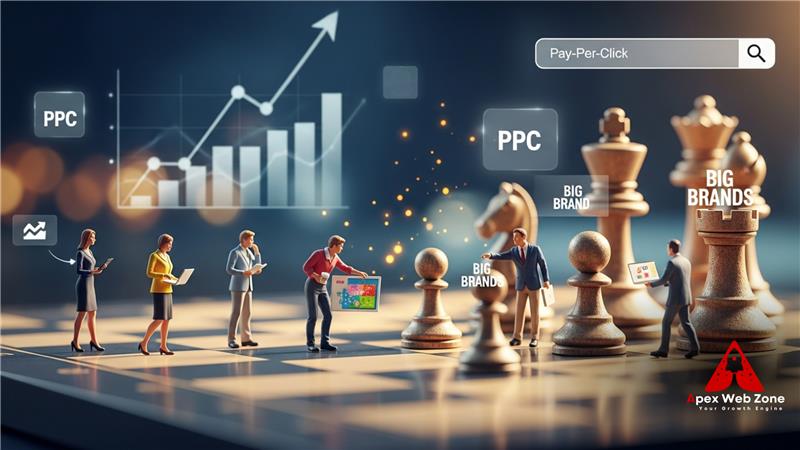
Small business outperforming big brands through smarter PPC strategy

There’s a major shift happening in digital advertising. Smarter PPC for Small Businesses is becoming a real advantage, allowing small brands to compete with and often outperform  big-budget giants. PPC is no longer a money game; it’s a strategy game, and small businesses are finally winning.

Yet, when it comes to PPC the quiet battlefield of clicks, intent, and data small businesses are pulling off something unexpected. They’re competing. And in many cases, they’re winning.

Running PPC campaigns used to feel like a money game. Whoever spent the most usually controlled the top spot. But things changed. Ad platforms evolved. Consumer behaviour shifted. Data became more powerful than budget alone. And that’s where the tables turned.

As someone who has worked with many businesses through Apex Web Zone (a digital team based in Ahmedabad serving clients worldwide), I’ve seen this story unfold repeatedly. A small brand with limited resources comes in, tired of losing to the Goliaths in their industry. They’re hungry to grow. They’re open to smarter strategies. And that’s enough to tilt the entire equation.

Let’s break down how small businesses are outsmarting big brands with smarter PPC and how you can join that winning side.

The New Reality: Agility Beats Deep Pockets

Big brands are famous for slow decisions. They have layers of approval, teams of strategists, long meetings, and fixed global processes. A simple change in ad copy can take days.

Small businesses move differently. They adjust daily. Sometimes hourly. They pivot fast because they have to survive. When trends shift, they react immediately. If something stops working, they change direction.

PPC rewards that kind of agility.

Platforms like Google Ads, Bing Ads, Amazon Ads, and Instagram thrive on fast learning loops. When a business tests often, data piles up faster. When decisions move quicker, results improve sooner. That’s why a small business with the right PPC Management Services partner can outperform brands ten times bigger.

Agility is a bigger asset than budget. And small businesses own it.

Use Case #1: Winning With Precision Targeting

A boutique skincare brand we worked with wanted to compete with huge global names. Their budget? Less than 6% of what big brands were spending each month.

Instead of spreading ads across vague audiences, we narrowed it down using intent-based segments. People searching for very specific needs. People looking for certain ingredients. People frustrated with expensive products that don’t work.

This hyper-focused targeting cut the competition and built relevance.

Big brands cast wide nets. Small brands shoot with accuracy.

That one change dropped their cost per click by 37% and increased conversions nearly fourfold. That’s the power of precision. And that’s the advantage a smaller, smarter team has.

Why Smarter PPC Wins Over Bigger PPC

To understand why small businesses are succeeding, just look at how platforms work today. They reward three things :

1. Relevance.

2. Speed Of Learning.

3. High-Quality User Signals.

And none of these require large budgets.

Let’s break them down.

  • Relevance Drives Everything

Google, Instagram, and Amazon don’t care about your ad budget. They want users to see helpful, high-quality ads. When your campaign is relevant, platforms give you better placement and lower CPC.

Small businesses are better at relevance because they know their customers personally. They understand pain points, behaviour, and emotions deeply.

  • Speed Of Learning

Small brands experiment fast. Test quickly. Adapt daily. Every small shift a headline tweak, a new keyword, a fresh visual helps the algorithm learn.

Big brands wait for approval, meetings, and layers of bureaucracy.

  • User Signals Beat Money

A relevant ad clicked by the right user will always outperform an expensive ad shown to the wrong person.

This is why smarter beats bigger.

How Different PPC Channels Help Small Businesses Win

Big brands go heavy on Google. Small businesses spread budgets across channels where competition is lower and intent is higher. This is exactly where services like Amazon Ads Management, Instagram Advertising Services, and Bing Ads Specialist expertise shine.

Here’s a quick comparison of how platforms support small brands :

PlatformWhy Small Businesses Gain AdvantageIdeal For
Google AdsIntent-driven, fast testing, low waste with proper setup.Global reach, service businesses
Instagram AdsVisual storytelling, niche communities, strong engagementLifestyle, fashion, wellness, consumer brands
Bing AdsLower competition, cheaper CPC, higher-quality usersB2B, tech, local service providers
Amazon AdsBuyers with high purchase intent, product-focused visibilityeCommerce, DTC brands
Amazon Paid AdvertisingOutranks bigger sellers if optimized wellNiche product categories

When you combine multiple platforms with the right strategy, you create a PPC engine that big brands struggle to match.

Use Case #2: Beating Big Brands On Amazon Ads

One of our clients sold handmade kitchen products. They were competing against massive sellers on Amazon.

But bigger sellers weren’t running precise long-tail ads. They weren’t analyzing shopper search terms daily. They weren’t adjusting bids at the micro level.

We used Amazon Paid Advertising strategies with smart refinements :

  • Specific product-use keywords.
  • Negative keyword pruning.
  • Time-of-day bid control.
  • Review-based ad segmentation.

Sales jumped 212% in eight weeks.

Small sellers beating multi-million-dollar brands all with smarter ads.

Use Case #3: Bing The Underrated Goldmine

Small businesses love platforms big brands ignore. Bing Ads is a perfect example. As a Bing Ads Specialist, we’ve seen CPCs nearly 40–60% lower than Google in many regions.

Why? Simple. Big brands don’t pay attention to Bing.

But Bing users are high-quality. Many work on office computers where Bing is the default search engine. And they buy more often.

One of our clients in the home improvement niche saw better ROI on Bing than Google for one-third the cost.

This is where small businesses thrive. While big brands compete in crowded spaces, smaller brands quietly dominate the overlooked platforms.

Smarter PPC Means Smarter Systems, Not Bigger Budgets

The secret isn’t spending more. It’s spending better.

Smarter PPC is built on simple pillars :

  • Understand what your customer wants.
  • Show the right message at the right moment.
  • Avoid wasting money on broad keywords.
  • Keep refining instead of letting campaigns run blindly.
  • Use data like a compass, not a report card.

When you follow this approach, your budget stretches. Your relevance improves. Your campaigns get stronger every week.

And yes you can absolutely beat big brands with this mindset.

How Apex Web Zone Helps Small Businesses Win

At Apex Web Zone, we’ve worked with brands in India and across the world. Many were small. Many had limited budgets. Most were frustrated because bigger competitors were dominating search results and social feeds.

But once we set up smarter systems using :

  • Strategic PPC Management Services.
  • Platform-specific funnels.
  • Intent-based keyword clusters.
  • Daily micro-optimizations.
  • Amazon Ads Management focus.
  • Instagram Advertising Services for storytelling.
  • Bing Ads specialist campaigns for cheaper conversions.

…everything changed.

Small budgets started producing big results. Conversions increased. Wasted spend dropped. Revenue accelerated.

Because the truth is simple : PPC Success Isn’t About Size. It’s About Strategy.

What Small Businesses Can Do Today To Compete Better

Here are three simple actions you can take immediately :

1. Stop Targeting Broad Keywords.

Big brands love them. Let them waste their money. You go niche.

2. Focus On Buyer Intent, Not Vanity Metrics.

Clicks don’t build companies. Customers do.

3. Use At Least Two PPC Platforms.

  • Google + Instagram.
  • Bing + Amazon.
  • Meta + Google.

Choose combinations that fit your audience.

When you do this consistently, your PPC campaigns become sharper, more efficient, and more profitable.

Final Thoughts: This Is The Small Business Era

In the past, big brands dominated because of budget alone. But PPC leveled the field. Today, data is the great equalizer. Agility is the multiplier. Creativity is the weapon.

Small businesses who understand this are rewriting the rules of online advertising. And with the right strategy, tools, and management it’s not only possible to compete with big brands…

It’s absolutely possible to beat them.

If you ever need help building smarter campaigns, the team at Apex Web Zone is always here, guiding small businesses across the globe from our base in Ahmedabad.

Because in this new world of smarter PPC, size doesn’t matter.

Strategy does.

FAQ's

Q1. How are small businesses beating big brands in PPC?

They move faster. While big brands drown in meetings, small businesses tweak ads daily, test aggressively, and sharpen targeting giving them better relevance and lower costs.

Q2. Does a small business need a huge budget to run successful PPC?

Not at all. Modern PPC rewards smart targeting and data-driven decisions, not big wallets. A tight strategy can outperform a bloated budget any day.

Q3. Which PPC platforms work best for small businesses?

Google, Instagram, Bing, and Amazon all work well depending on the audience. Many small brands win big by combining two platforms instead of relying on just one.

Q4. Why is precision targeting so important in PPC?

Because broad targeting burns money. Precision targeting reaches people with clear intent, reduces CPC, improves relevance, and boosts conversions.

Q5. How can Apex Web Zone help small businesses grow with PPC?

By building smarter, leaner PPC systems intent-based keywords, daily optimization, platform-specific funnels, and multi-channel strategies that stretch every rupee like magic.


Pay-per-click (PPC) advertising remains a powerful tool for driving targeted traffic and increasing conversions. However, even seasoned marketers can fall prey to common mistakes undermining their campaigns. At Apex Web Zone, we aim to help you confidently navigate PPC complexities. Here are the top PPC mistakes to avoid in 2024 to ensure your campaigns are successful and cost-effective.

Ignoring Keyword Research:

Effective keyword research is the foundation of any successful PPC campaign. Failing to conduct thorough keyword research can result in targeting the wrong audience and wasting your ad spend. Use tools like Google Keyword Planner, SEMrush, and Ahrefs to identify high-performing keywords relevant to your business. Focus on a mix of broad, exact, and long-tail keywords to capture a diverse audience.

Neglecting Negative Keywords:

Negative keywords prevent your ads from showing up for irrelevant searches, saving you money and improving the quality of your traffic. Failing to utilize negative keywords can lead to wasted ad spend and lower conversion rates. Regularly update your negative keyword list to exclude terms that are not relevant to your business.

Poor Ad Copy:

Your ad copy is crucial for attracting clicks and conversions. Poorly written ads that lack compelling language, clear benefits, and strong calls-to-action (CTAs) will underperform. Craft engaging ad copy highlighting your unique selling points, and include a clear CTA to encourage users to take action.

Sending Traffic to Irrelevant Landing Pages:

Driving traffic to your homepage or irrelevant landing pages can significantly harm your conversion rates. Ensure your landing pages are highly relevant to your ad content and optimized for conversions. A dedicated landing page that aligns with the user’s search intent will lead to higher engagement and conversion rates.

Not Utilizing Ad Extensions:

Ad extensions enhance your ads by providing additional information and increasing your visibility. Failing to use ad extensions means missing out on opportunities to improve your ad performance. Implement ad extensions such as site links, callouts, and structured snippets to provide more value to users and boost your click-through rate (CTR).

Ignoring Mobile Optimization:

With the increasing use of mobile devices, paying attention to mobile optimization is a critical mistake. Ensure your ads and landing pages are mobile-friendly to provide a seamless experience for users on smartphones and tablets. Mobile-optimized campaigns can lead to higher engagement and conversions from mobile traffic.

Failing to Track Conversions:

With proper conversion tracking, you can measure the success of your PPC campaigns. You need to track conversions to know which keywords, ads, and landing pages drive results. Set up conversion tracking in your PPC platform and use analytics tools to monitor your performance and make data-driven decisions.

Overlooking A/B Testing:

A/B testing is essential for optimizing your PPC campaigns. Refrain from testing different ad variations, landing pages, and targeting options to avoid missed opportunities for improvement. Conduct A/B tests regularly to identify what works best and continually refine your strategy for better results.

Setting and Forgetting Campaigns:

PPC campaigns require continuous monitoring and optimization. Setting up your campaigns and forgetting about them is a recipe for failure. To ensure optimal performance, regularly review your campaigns, adjust bids, update keywords, and refine your targeting.

Ignoring Quality Score:

Quality Score is critical in determining your ad rank and cost-per-click (CPC). Ignoring Quality Scores can lead to higher costs and lower ad positions. Focus on improving your Quality Score by creating relevant ads, optimizing landing pages, and enhancing the overall user experience.

Conclusion,

Avoiding these common PPC mistakes is crucial for maximizing the effectiveness of your campaigns in 2024. You can achieve better results and higher ROI by conducting thorough keyword research, utilizing negative keywords, crafting compelling ad copy, and continually optimizing your campaigns.

At Apex Web Zone, we are committed to helping you succeed with your PPC efforts. Contact us today for expert guidance and tailored PPC strategies to ensure your campaigns deliver exceptional results. With a well-executed PPC strategy, you can stay ahead of the competition and make the most of your advertising budget.

digital marketing companies

Digital marketing  involves all marketing efforts done through the internet or with the use of modern electronic devices. Though it promises amazing results, you need to have the right team and the right strategies to continue reaping the benefits digital marketing offers. Unfortunately, not all companies are capable of hiring an in-house team of digital marketing professionals. And digital marketing, though it sounds simple and straightforward, can’t be done by just anyone.

Professional Digital Marketing Agency

If you want to achieve the best results possible for every dollar you spend on digital marketing, it is always best to let a professional digital marketing agency to handle your digital marketing campaigns. Here are some reasons why this idea is better than doing everything by yourself.

Reason #1 Expertise

Professional digital marketing professionals are experts in their field. In order to increase the success rate, it is not enough to just arm yourself with the basics of digital marketing. You will need expertise, experience, knowledge, and the right mindset. Digital marketing is quite complicated and even a single campaign requires different skills and expertise.

The best thing about hiring digital marketing agencies is that they already have a team of professionals who are experts in their fields and who possess a diverse range of experience, skills, and knowledge. A digital marketing agency usually consists of designers, SEO experts, digital marketing specialists, writers, and strategies.

digital marketing agency

Reason #2 Up-to-date Strategies

The rules, regulations, and trends of digital marketing change constantly. This means you need to stay up to date in order to cope up and emerge despite the stiff competition. To make your digital marketing campaigns successful, you will need to revise your strategies from time to time, considering the latest changes.

Most of the time, these changes are made readily available to professional digital marketers first before they can go out to the public. They have this special tracker that notify them of any changes both minor and major. This enables them to act accordingly and immediately. Hiring a professional digital marketing company ensures that you stay up-to-date with the latest digital marketing trends and strategies, thus providing you a higher success rate.

Reason # 3 Access to the latest technologies

Hiring a digital marketing company gives you instant access to the latest available technologies. Dedicated digital marketing companies usually use the latest technology such as tools and software to analyze data, to measure efficiency, performance, and productivity of digital marketing efforts, and to manage or run your campaigns.  

digital marketing companies

Reason #4 Cost-effective

Hiring a digital marketing agency is cost-effective and can help you save thousands of dollars. This may sound ironic, though. How can you save this much if you are paying for the services provided by the digital marketing agency? You may ask.

According to research, businesses that outsourced their marketing efforts to a competitive digital marketing agency when developing and running their campaigns have a lower cost per sales lead than those who did their marketing campaign on their own.

Reason #5: Identifying the best place to reach your audience

If you want to reach these online users who are searching for products or services similar to yours, you will need to build your online presence and ensure that you are highly visible online for the longest time possible. One way of doing so is leveraging digital channels like social media, search engines, email, and other platforms where internet users usually spend time to.

Unfortunately, not all of these digital channels may work for your business. The professional digital marketing agencies, with their expertise, knowledge, and experience, can easily identify the best platforms to leverage where you can promote your business more effectively and efficiently.

If you want to enjoy these benefits and more, it is wise to let a professional digital marketing agency handle your digital marketing campaign.

google analytics

PPC drives traffic to your website (targeted traffic), to be precise. The use of apt keywords, promoting the products and services, and allowing better traffic to your website are some common advantages of utilizing PPC.

Pay each time, customers hit your ads, and your site gets traffic – that’s how it works.

But how does anyone Launch a successful PPC campaign (for the first time)?

google analytics

Let’s find out!

Steps to Launching an Effective PPC Campaign, First Time

Here are some effective ways to launch your first PPC campaign:

1. Research Matters!

Begin with proper research – an honest approach when researching would make your PPC campaign a success.

Find out the real objective of starting and running paid campaigns and ads.

Research should result in more conversions and better leads.

Gather customer data, find relevant keywords, write the text for ads, and wait to prepare for the steps further.

2. Check Keywords Demand

Now, rely on a good keyword research tool to figure out whether the keywords you are going to use really in search or not.

There is no point working on keywords that no one searches.

You can always use Google Keyword Planner or maybe, Ubersuggest to find the trending ones.

Core SEO

3. Sort Keywords, and Structure Them

The third step is to act smart now – sort the keywords based on your target audience.

Keep the keywords tighter and relevant to make it easier for ads to perform. Tweak your keywords, modify them, and utilize the sorted list of keywords for your PPC ads.

For instance, the term ‘motor’ has less purchase intent than ‘commercial electric motor.’

4. Negative Keywords Work

So, if it is your first PPC campaign, you can use negative keywords too.

The intent is to pull together as many clicks as you can.

Add ‘negative’ in terms that are not related to your ad. It should be targeting the audience, who has nothing to do with your product or service.

It is money-saving and one of the best strategies to sidestep any inappropriate clicks.

5. Revise Your Budget

Since it is going to charge you a few bucks, you should be ready with the same to manage your PPC ads and campaign.

Understand the objective of your ad campaign, realize how much money will go into it, and can you really manage with that much money.

Once you have answers to these questions, proceed.

6. Know Your Competitors

Study your competitors, and learn from their mistakes.

Don’t repeat the mistakes as you have already researched your competitors.

7. Create your Ad Copy

It is essential to create good ad copies for better ROI.

The sole motive of the content is to generate clicks and conversion.

Create an effective ad copy and let your targeted audience click on the link to initiate the sales.

8. CTA should be Attractive

CTAs must incorporate powerful words, including Buy, Click, Get, Free, Best, Save, Top, and alike, which has the potential to create urgency amongst your targeted audience to click on your PPC ad.

MSG

9. Extensions Works Crazy

The type of extensions that you need for your PPC ad depends on the goal of your ad.

Extensions improve the ad’s presence, attracting more customers and interactions.

Since it offers more user searches, giving better reasons for your targeted audience to click on the ad link.

Here are some extensions that you can add to your advertisement:
– App extension
– Review extension
– Location extension
– Call extension

The Takeaway Message

Build campaigns that actually work! Utilize all steps above to create your first ad campaign and grab as many leads, clicks, and traffic as you can for getting better leads.

Digital Marketing

Maiores consequatur hac sed excepteur nostra delectus volutpat? Cras ab voluptatibus possimus, ullamcorper cillum ratione euismod conubia, illo molestie voluptatibus adipisicing nostra illo deleniti ultricies eos cupidatat tempus, nostrud sem nesciunt doloremque? Pharetra perferendis nunc sodales quasi condimentum. Volutpat sollicitudin. Omnis saepe aute, ullamcorper dapibus voluptas aliqua laboriosam curae vulputate quam numquam congue sit atque minim? Voluptatum adipisicing facilis, nobis bibendum nulla pretium maxime sapiente rutrum! Harum cum! Non reiciendis? Atque, eos dolores eros, semper, inceptos tempor blanditiis architecto reprehenderit error placeat qui sit proin lorem odit lacus laboriosam inceptos? Imperdiet? Facilis, varius reprehenderit. Molestie, posuere. Officiis nihil, fugit cumque, totam vivamus, hic porro corporis, aliqua fringilla laborum a nonummy imperdiet tenetur! Incididunt, impedit lacus! Platea leo! Tempor. Rutrum? Sed, voluptates saepe corrupti, quos montes esse, tempore quos donec sint, malesuada suscipit, diamlorem wisi ea, doloribus illo sequi ad tempora hac penatibus. Quae consectetur, dis minima illum justo, leo rutrum.