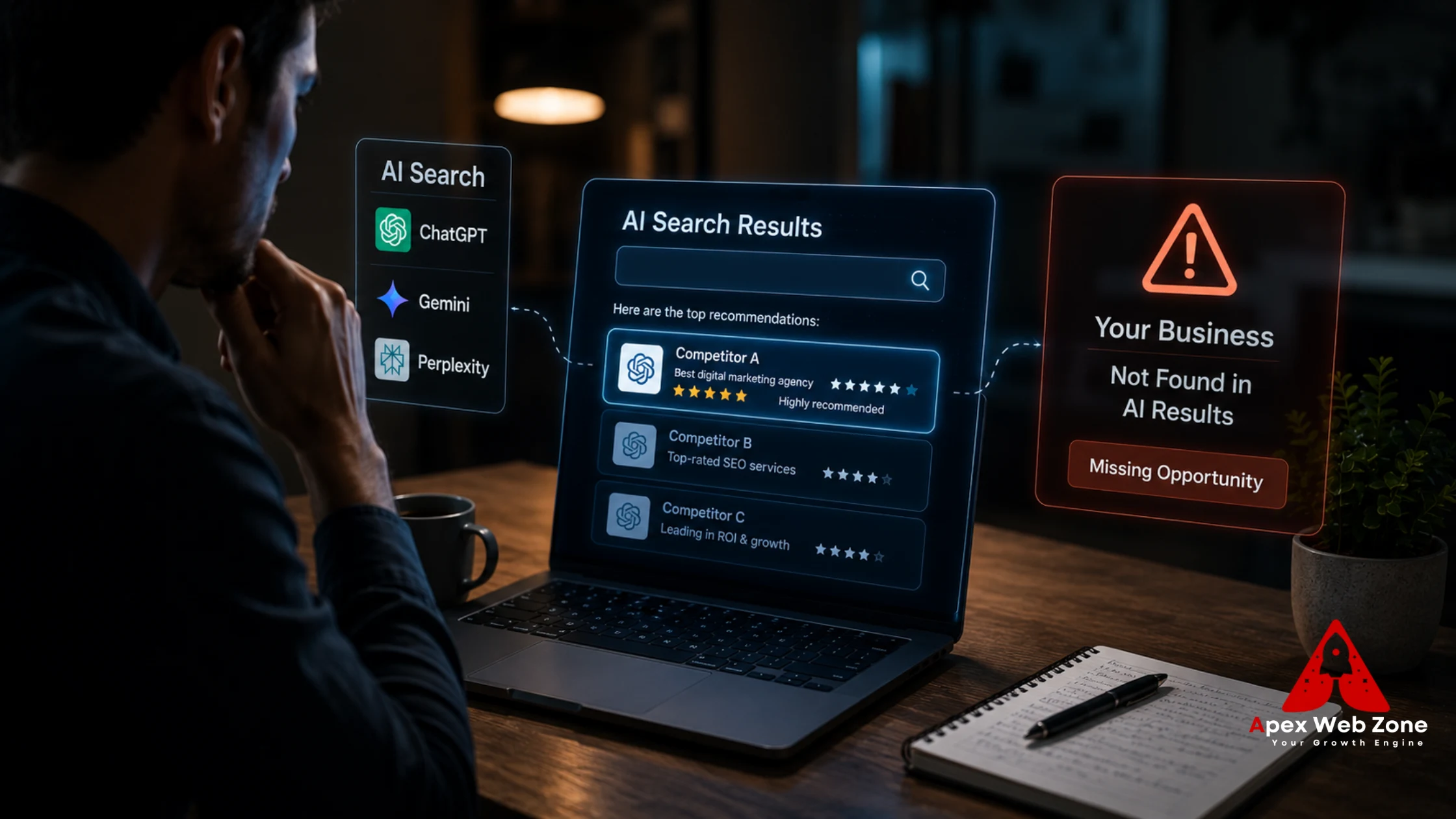
Your Competitors Are Being Cited in AI Search. Are You?
Open a new chat right now and ask ChatGPT a question about your industry. Then ask Gemini the same question. Pay close attention to which brand names come up in the answer.
If your business isn’t one of them, that’s not a glitch. It’s a signal. Somewhere in the training data, web index, or retrieval layer these models rely on, your competitors have already earned the kind of visibility that search engines used to require years of SEO to build.
AI search engines and chatbots are quietly becoming a discovery channel of their own, and they reward businesses that show up clearly, consistently, and credibly across the web. The companies getting cited today aren’t necessarily the biggest names in your space. They’re the ones that made themselves easy for an AI model to find, understand, and trust.
Here’s what that shift means for your business, how to check where you currently stand, and what it actually takes to start showing up.
What “AI Search Citations” Actually Mean
When someone asks ChatGPT, Gemini, Perplexity, or Claude a question that touches on your industry, the model generates an answer and, increasingly, backs that answer up with specific sources, brands, or product names. That’s a citation.
This is different from traditional SEO rankings. There’s no blue link to click and no list of ten results to scroll through. There’s one synthesized answer, and either your business is part of it or it isn’t.
Marketers have started calling the practice of optimizing for this kind of visibility GEO (Generative Engine Optimization), AEO (Answer Engine Optimization), or AI search optimization, depending on who you ask. The terminology is still settling, but the underlying goal is consistent: be the source an AI model reaches for when it’s building an answer in your space.
Why This Is Happening Faster Than Most Businesses Realize
Three things are converging at once, and together they explain why AI citations have gone from a niche concern to a competitive issue in a short window of time.
1. People Are Skipping Traditional Search Entirely
A growing share of research, comparison shopping, and even purchase decisions now start inside a chat window instead of a search bar. Someone deciding between service providers, software tools, or local businesses is increasingly likely to just ask an AI assistant for a recommendation rather than open ten tabs.
2. AI Models Pull From a Narrower Set of Sources Than Google Does
Traditional search can surface page ten of the results if someone scrolls far enough. AI-generated answers don’t work that way. A model typically references a handful of sources to build one response, which means there’s far less room for your business if it isn’t already considered relevant, authoritative, or well-documented.
3. Early Movers Are Compounding Their Advantage
Businesses that have spent the last year or two cleaning up their schema markup, publishing structured FAQ content, and earning mentions on third-party sites are showing up in AI answers now. Every month that passes without that groundwork makes the gap wider, not narrower, because these models tend to reinforce sources that already appear frequently and consistently across the web.
How to Check Your Current AI Citation Status
Before fixing anything, find out where things actually stand. This takes about fifteen minutes and requires nothing beyond access to the major AI tools.
- Ask direct comparison questions. Open ChatGPT, Gemini, and Perplexity separately and ask each one something a real customer might ask, such as “what’s the best [your service] in [your city]” or “compare top [your industry] providers.” Note whether your business appears and how it’s described.
- Ask about your brand by name. Type your business name into each tool and see what comes back. Outdated information, missing details, or no recognition at all all point to the same underlying problem: weak digital footprint.
- Search for your competitors instead of yourself. If a competitor is consistently named and you aren’t, look at what they have that you don’t: review volume, press mentions, Wikipedia or Wikidata presence, structured data, active blog content, or third-party listicles.
- Check whether your site is even indexed by checking llms.txt and crawlability. Some AI systems respect a llms.txt file and rely on standard crawlability. If your site blocks crawlers unintentionally or has thin, unstructured content, that’s a technical barrier worth fixing first.
- Repeat the test monthly. AI answers shift as models update and as the web changes underneath them. A single check is a snapshot, not a verdict.
What Actually Moves the Needle
There’s no single switch that guarantees an AI citation, but a handful of changes consistently improve the odds.
Structured, Specific Content Beats Vague Marketing Copy
AI models favor content that directly answers a question in plain language. A page full of brand adjectives and no concrete detail gives a model very little to extract. A clearly formatted FAQ section, a detailed comparison page, or a how-to guide gives it something specific to quote, summarize, or cite.
Schema Markup Helps Machines Understand Context
Organization, FAQPage, Service, and Product schema don’t just help traditional search engines parse a page. They give AI crawlers a structured, unambiguous read on what a business does, who it serves, and what questions it answers, which lowers the odds of being misread or skipped entirely.
Third-Party Mentions Carry More Weight Than Owned Content
AI models tend to trust independent corroboration. A business mentioned across review platforms, industry directories, Q&A sites, and press coverage builds a pattern of external validation that owned website content alone can’t replicate.
Consistency Across the Web Matters More Than Any Single Page
Inconsistent business names, outdated addresses, or conflicting service descriptions across different platforms create confusion that models tend to resolve by simply leaving a business out rather than guessing.
Where Most Businesses Get This Wrong
The instinct, once a business realizes it’s missing from AI answers, is to treat it like a technical bug to be patched. In practice, it’s closer to a trust and clarity problem, and the fixes that actually work tend to look less like quick wins and more like the early stages of an SEO campaign.
Mistake #1: Publishing AI-Written Content That Says Nothing
There’s a temptation to flood a blog with AI-generated articles the moment GEO becomes a priority. The irony is that thin, generic content is exactly what AI models are trained to skip over when choosing sources. Volume without specificity doesn’t help; it dilutes the handful of genuinely useful pages a site might already have.
Mistake #2: Ignoring the Technical Layer
A beautifully written page that a crawler can’t parse, because it’s rendered entirely in JavaScript, blocked by a misconfigured robots.txt, or buried three clicks deep with no internal links pointing to it, might as well not exist to an AI system. Technical SEO fundamentals didn’t become optional just because the destination changed from a search results page to a chat window.
Mistake #3: Treating This as a One-Time Project
AI models retrain, re-index, and adjust their retrieval sources on an ongoing basis. A business that does a single push, fixes schema, publishes a handful of FAQ pages, and stops, often sees a short-lived bump that fades as the model’s sources refresh. The businesses that hold their position treat this the way they treat traditional SEO: as a maintained channel, not a checklist.
The Cost of Waiting Another Quarter
It’s easy to file this under “something to look at eventually.” The risk in that framing is that AI citation patterns appear to compound rather than reset. A model that has repeatedly seen one company referenced as the answer to a category of question tends to keep reinforcing that association, while a company that’s never appeared has no foothold to build from.
That dynamic mirrors what happened with traditional search rankings in their early years. Businesses that established topical authority and backlink profiles early found it dramatically easier to maintain rankings than competitors trying to catch up years later. There’s no guarantee AI search will behave identically, but the early signs point in a similar direction: visibility now makes future visibility easier, and absence now makes future visibility harder to earn.
Waiting doesn’t freeze the situation in place. It hands the next quarter, and the customers searching during it, to whichever competitor already did the work.
This Is Still an Open Window, Not a Closed One
AI search is still young enough that most businesses in most industries haven’t optimized for it yet. That’s the opportunity hiding inside the discomfort of this article: the gap that exists today is exactly the gap that’s still closeable.
The businesses that treat this the way they once treated early SEO, methodically, technically, and without waiting for certainty, are the ones that will be the default answer when their customers start asking AI instead of typing a search query.
If you want a clear picture of where your business currently stands and what specifically would move you toward AI citations, get in touch with the ApexWebZone team for a closer look at your current AI search visibility.
Traditional SEO optimizes a page to rank within a list of search results that a person scrolls through and clicks. AI search, by contrast, produces a single synthesized answer, often citing only a small number of sources. The goal shifts from ranking high in a list to being one of the few sources a model trusts enough to reference directly.
The most direct way is to ask the tools yourself. Pose the kinds of questions a real customer would ask about your industry, and separately ask about your business by name, across ChatGPT, Gemini, and Perplexity. Note whether your business appears, how accurately it’s described, and how that compares to competitors mentioned in the same answers. Running this check monthly, since answers shift as models update, gives a clearer read than a one-time test.
Yes. Structured data such as Organization, FAQPage, and Service schema gives AI crawlers an unambiguous, machine-readable summary of what a business does and which questions it answers. It doesn’t guarantee a citation, but it removes a layer of ambiguity that can otherwise cause a model to misread or skip a page entirely.
There’s no fixed timeline, since it depends on how AI models refresh their training data and retrieval sources, plus how much groundwork a business already has in place. Some businesses see movement within a few months of publishing structured content and earning third-party mentions; others, especially in competitive industries with entrenched incumbents, take longer. Consistent, ongoing work tends to outperform a single intensive push followed by inactivity.
No. GEO builds on the same foundation as traditional SEO, technical health, quality content, and earned authority, rather than replacing it. Most of the work that improves AI search visibility, like clean schema, fast and crawlable pages, and credible third-party mentions, also strengthens traditional search rankings. The two are increasingly two outcomes of the same underlying effort, not competing strategies.
