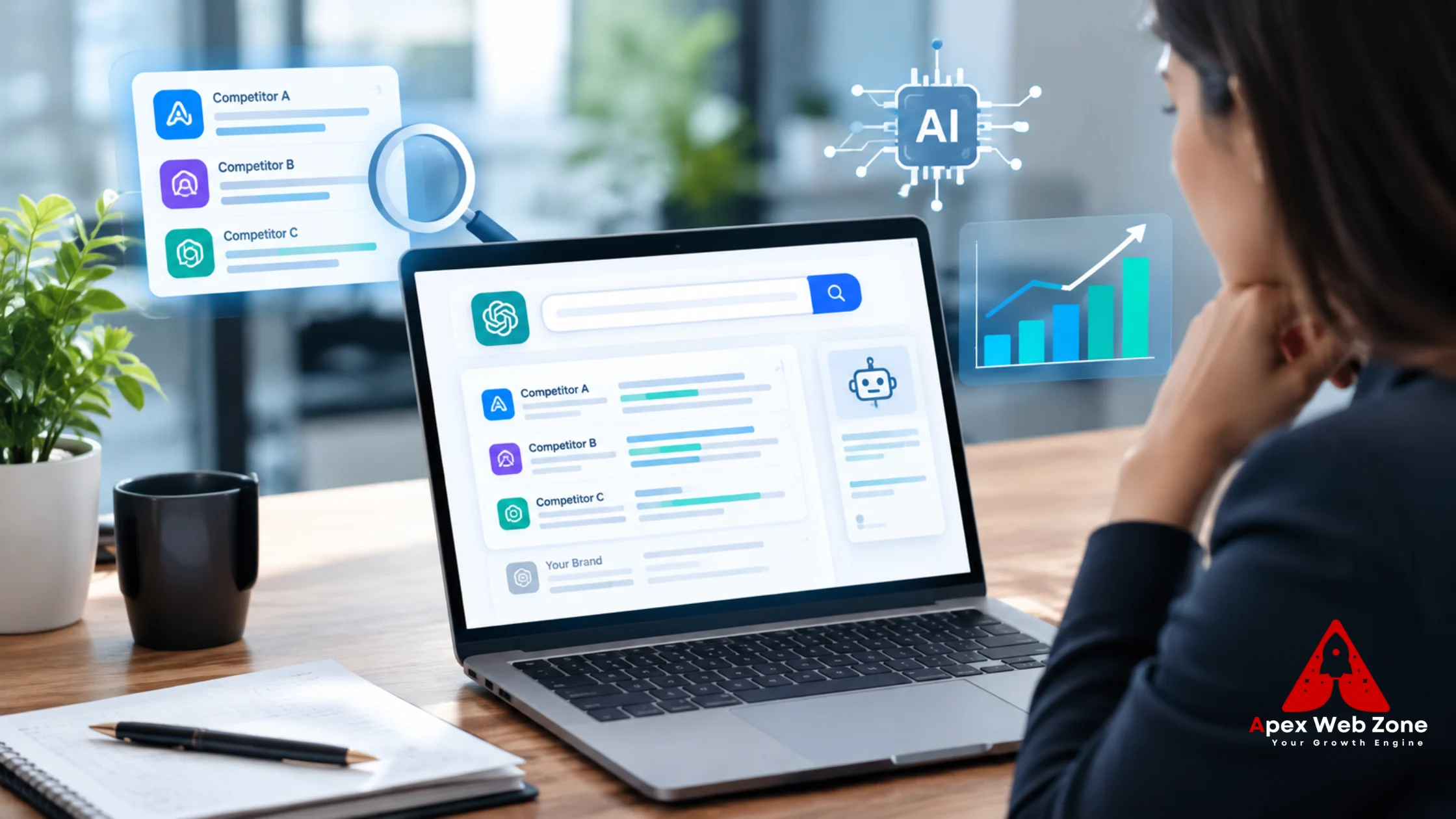
How to Check If Your Competitors

Short answer: Yes, you can check, but not with a single prompt. Build a set of 20 to 30 buyer-style questions, run each one several times in ChatGPT, Perplexity, Copilot and Gemini, and log which brands are named and which URLs are cited. Then calculate your mention rate, citation rate and share of mentions against each competitor, and list the third-party sites that get cited for them but not for you. Those source gaps tell you what to fix first. Treat any one-off answer as an anecdote, because AI tools almost never return the same brand list twice.

You open ChatGPT, ask for providers in your category, and a competitor is named first. Your brand isn’t there. It is tempting to treat that as proof you are losing, or as a glitch to ignore. It is neither. It is one sample from a system designed to give different answers every time.

This guide gives you a repeatable method instead: what to ask, how to run it, what to log, which numbers to calculate, how to score sentiment, and how to turn the results into a fix list. It is vendor-neutral and works with free accounts and a spreadsheet. If you only want the overview of why AI citations matter, start with our earlier post on competitors being cited in AI search. This post is the measurement manual that follows it.

What you need: a spreadsheet, accounts on the four AI tools (free tiers are enough to start), a list of three to five competitors, and roughly three to four hours for the first full run. After that, a monthly refresh takes about half that.

Why can’t you just ask the AI once and compare?

Because the answers are probabilistic. In research published in January 2026, SparkToro and Gumshoe had 600 volunteers run 12 prompts through ChatGPT, Claude and Google’s AI features, for 2,961 runs in total. The chance that any two responses contained the same list of brands was under 1 in 100, and the chance of the same order was closer to 1 in 1,000. The lists also varied in length, from 2 or 3 recommendations to 10 or more.

That sounds like bad news for tracking, but the same research found a usable signal. Across many runs of the same prompt, some brands appear again and again. In one example, a single agency appeared in 85 of 95 Google AI responses. The authors concluded that visibility percentage across dozens to hundreds of prompt runs is a reasonable metric, while a brand’s exact rank position in an AI answer is mostly noise. Note that Gumshoe, which co-ran the study, sells AI tracking, and the authors list open questions such as how many runs are statistically enough.

So the method has two rules: measure how often you appear across many runs, not where you appear in one, and compare yourself to competitors using the same prompts under the same conditions.

What should you measure?

Five numbers cover most decisions. The first three tell you whether competitors are ahead. The last two tell you why.

Metric

How to calculate it

What it tells you

Mention rate

Responses that name your brand ÷ total responses

How often you are in the consideration set

Citation rate

Responses that cite a URL from your domain ÷ total responses

How often your own content is used as a source

Share of mentions (share of model)

Your mentions ÷ all brand mentions across tracked brands

Your slice of the conversation versus competitors

Source gap

Domains cited alongside competitors but never alongside you

Where to earn presence

Sentiment and accuracy

Score each mention as positive, neutral or negative, and correct or incorrect

Whether being mentioned helps you

Keep mention rate and share of mentions apart. Similarweb’s published example shows why: a retail brand appeared in 32.77% of tracked AI answers, yet held only 4.71% of all brand mentions across them. It was present often but outnumbered by competitors named alongside it.

Bing’s documentation draws a similar line between volume and share. Total citations measure how often your content is referenced, while citation share measures your portion of the citations for one grounding query.

How do you check which competitors AI search engines cite? A 9-step method

Step 1: Define who and what you are tracking

List your brand and three to five direct competitors. Include the variants a model might use: the full company name, the short name, the product names, and the domain. Add one or two “wildcard” competitors, such as a directory, marketplace or large publisher that tends to appear in answers for your category. AI answers often name sources you do not think of as competitors.

Step 2: Write 20 to 30 prompts in your buyers’ words

People do not prompt like they search. SparkToro’s survey of 142 volunteers found almost no two prompts alike, even when the intent was the same, yet the AI tools still returned a fairly consistent set of brands for that intent. So write prompts that cover intent, not exact wording. Use four groups:

  • Category: “What are the best providers for a [company type] in [market]?”
  • Problem: “Our [metric] dropped after [event]. Who can help and what should we do first?”
  • Comparison: “Compare [Brand A], [Brand B] and [Brand C] for [use case].”
  • Brand and reputation: “Is [Brand] a good choice for [use case]? What do customers say?”

Orbit Media notes that prompts are more likely to trigger a live web search, and therefore citations, when they are very specific, ask for current information, ask for sources, or concern a high-stakes decision. Include some of each, such as “in 2026” or “with sources”. Draw wording from sales calls, support tickets and the questions prospects ask on discovery calls rather than from a keyword tool.

Step 3: Standardise the test conditions

The SparkToro volunteers used default settings and results still varied, so you cannot remove variance, but you can keep it from distorting your comparison:

  • Start a new chat for every run so earlier answers do not bias later ones.
  • Turn off memory and custom instructions where you can, because ChatGPT may use saved memories when it rewrites a search query.
  • Use the same country and device. ChatGPT may infer approximate location from your IP address, and a VPN can change it.
  • Record the date, tool, plan (free or paid) and whether web search was on.
  • Change the prompt set only on a planned schedule, and version it (v1, v2), so month-to-month numbers stay comparable.

Step 4: Run each prompt several times on each platform

A workable minimum for a small business is 25 prompts × 3 runs × 4 platforms = 300 responses. A more robust run is 5 runs per prompt. SparkToro suggested 60 to 100 runs of a single prompt for a precise picture of one consideration set, which is impractical across a full prompt library, so treat your own numbers as directional and widen the sample over time. That recommendation is ours, not an established standard.

Interfaces change often, so log what each tool actually shows rather than assuming:

Platform

How to get sources

Record

Watch out for

ChatGPT

Use the Search tool (View all tools, then Search) or ask for current information; open Sources or the citation links

Brands named, cited URLs, whether search ran

In August 2026 some accounts showed sources only under a three-dot menu, so check there. OpenAI notes citations can be incomplete or incorrect

Perplexity

Read the source links shown with the answer

Brands named, cited domains

Run in a fresh thread each time

Microsoft Copilot

Open the links or references shown with the answer

Brands named, cited domains

Bing’s AI Performance report covers Copilot citations for your own site only

Gemini

Check the sources or links the answer displays

Brands named, cited domains

If no sources appear, log “no citations”, which is itself a result

Google’s AI Overviews and AI Mode are separate surfaces. Measure those with Search Console (Step 9), and add them to the manual run only if your buyers use them for research.

Step 5: Log every response in a simple sheet

One row per response. Paste the full answer into a separate column or tab so you can recheck it later.

Date

Tool

Prompt ID

Run #

Search used?

Brands named (in order)

Your brand named?

Cited domains/URLs

Sentiment (-1/0/+1)

Accuracy (ok/outdated/wrong)

Notes


Two habits keep the data clean. First, log brands and domains exactly as shown, then normalise them (for example, “G2”, “g2.com” and “G2 Crowd” become one entry) in a second pass. Second, record the order if you like, but do not build a KPI on it, since order is the least stable part of an AI answer.

Step 6: Calculate your share of model

Once the log is full, three formulas give you the comparison. The numbers below are illustrative only, to show the arithmetic, not real results.

Suppose you ran 25 prompts × 4 runs × 4 platforms = 400 responses. Across them, tracked brands were named 500 times in total.

Brand

Responses naming it

Mention rate

Share of mentions

Responses citing its own domain

Citation rate

You

84

21%

16.8%

36

9%

Competitor X

188

47%

37.6%

112

28%

Competitor Y

120

30%

24.0%

52

13%

In this example Competitor X is named in more than twice as many responses as you and gets its own pages cited three times as often. That is a real gap. A smaller difference, such as 21% against 24%, could easily sit inside the noise. With 400 responses, a proportion near 50% carries a margin of roughly ±5 percentage points at best, and less at the extremes, and runs on the same prompt are not fully independent, so treat that as a floor. Only act on gaps that are large, that appear on several platforms, and that repeat in the next monthly run.

Break the table down by prompt group and by platform too. A common pattern is strong mention rate on brand and comparison prompts but weak presence on category and problem prompts, which is where new buyers start. Similarweb’s published analysis found the same shape: broad prompts surfaced familiar brands, while specific prompts about attributes or use cases changed the answers completely.

Step 7: Score sentiment and accuracy

Being named is not the same as being recommended. Orbit Media makes the point that visibility is the start, and the real goal is to be recommended. Score every response that names you with a short rubric:

Dimension

Scale

How to score

Sentiment

-1 / 0 / +1

+1 if described as a strong fit or recommended, 0 if listed neutrally, -1 if cautioned against or described with a weakness

Role

Recommended / Listed / Alternative / Warned

Where the answer places you in the decision

Accuracy

Correct / Outdated / Wrong

Check services, pricing, location and claims against your own site

Descriptors

Free text

The two or three words the model uses for you, such as “affordable” or “agency-focused”

Average sentiment by competitor, then read the actual descriptors side by side. They show you how each brand is positioned in the model’s eyes, which is often more useful than the number itself. Wrong or outdated statements are the cheapest wins, because you can usually trace them to a specific source and correct it.

If you use an AI tool to help classify a long log, treat it as a first pass and manually check a sample of about one in ten rows, since the classifier is subject to the same variability.

Step 8: Run the source-gap analysis

This step answers the question in your query: why are they cited and you are not. For every response, list the domains cited. Then classify each domain:

  • Owned: the brand’s own site.
  • Earned: news, press, industry publications and roundups.
  • Community: forums and Q&A sites such as Reddit and Quora.
  • Intermediaries: review platforms, directories and marketplaces.

Then build a simple domain table: for each domain, count the number of distinct prompts where it was cited, and note which brands appeared in the same answers. Scrunch calls a version of this an influence score, defined as the share of responses citing a source multiplied by the number of unique prompts it appears for. A hand-built count of prompts per domain is enough to start.

The gaps fall into three groups, borrowing TopCited’s useful framing:

  1. You have no content on the question. The engine cannot cite a page that does not exist.
  2. You have content, but you are not cited. Usually a structure or authority problem, not a subject problem.
  3. The question is not yours to win. Some answers come from a competitor’s own documentation or a reference site. Do not chase those.

The third-party domains that appear repeatedly across prompts and platforms are your target list. Similarweb’s example showed a handful of listicles and publisher pages shaping answers across dozens of prompts, which meant getting included there could matter more than publishing another page on the brand’s own site.

Step 9: Cross-check with the data AI platforms give you

Manual testing shows you competitors. Native reports show you yourself. Use both.

Google Search Console, Generative AI performance report. Google launched it on 3 June 2026 for a subset of sites, and its help page says it rolled out to all websites worldwide on 31 August 2026. It reports impressions for your pages in AI Overviews and AI Mode, split by page, country, device and date. It does not report clicks or competitors, so it tells you whether your pages appear, not who beat you.

Bing Webmaster Tools, AI Performance. Launched in public preview on 10 February 2026, it shows how often your site is cited across Microsoft Copilot, AI summaries in Bing and select partners. You get total citations, average cited pages, grounding queries and page-level counts. Bing says the data is a sample, a citation is not a click, and the newer Citation Share view does not reveal which competitors hold the rest.

Because neither report names competitors, the manual log is still the only way to see them. Use the native reports to confirm direction: if your Bing citations are flat while a competitor appears more in your Copilot tests, that is a consistent signal.

Which prompts should you use to check competitor citations and sentiment?

Copy these into your tools and replace the brackets. Run each several times in fresh chats.

Category discovery

I’m a [role] at a [company type] in [country]. Which 

 providers would you shortlist for [goal], and why? Please cite sources for each recommendation.

Head-to-head comparison

Compare [Brand A], [Brand B] and [Brand C] for [use case and budget]. Give strengths, weaknesses and who each is best for, with sources.

Reputation and sentiment

What do customers, reviewers and industry sources say about [Brand]? Separate positive points from complaints, and say where each claim comes from.

Problem-first (where new buyers start)

Our [symptom, e.g. demo requests fell while rankings held]. What are the likely causes, and which agencies or tools could help? Include sources.

Alternatives

I’m considering [Competitor]. What are the best alternatives for [use case], and what are the trade-offs?

One prompt to be careful with is the common suggestion to ask a model what its training data says about you, or which sites it relies on. The answer is a plausible-sounding guess, not a log of what the system did. Orbit Media itself cautions that a model’s tips for improving your odds are partly echoes of generic SEO articles. Use the sources actually cited in real answers as your evidence.

How do you read the results?

Match what you see to the likeliest cause before choosing a fix.

What the data shows

Likely cause

First move

Competitors named, you absent, on category and problem prompts

Weak topical coverage or weak third-party presence

Source-gap analysis, then content and earned mentions

You are named but never cited, and competitors’ own pages are cited

Your pages are less direct, less specific or less authoritative than theirs

Restructure the key pages and add original evidence

Mentioned on one platform but not another

Platform-specific retrieval or crawler access

Check crawler access and indexing for that platform

Named but described wrongly or negatively

Outdated or negative third-party sources

Correct at the source, strengthen first-party facts

Absent from everything

Entity not recognised, or site not reachable

Entity and access audit before content work

How do you fix it when competitors are cited more than you?

Work in this order. Access problems are quick to fix and block everything else, while earned mentions take longest, so start those early. No platform publishes a formula for citations and none guarantees one, so treat each step as improving your odds.

1. Make sure the right crawlers can reach you

OpenAI says that to be eligible for ChatGPT search results you should allow OAI-SearchBot and confirm your host or CDN allows traffic from OpenAI’s published searchbot IP addresses. For Google’s AI features, Google says a page must be indexed and eligible to show with a snippet, and the site must be included in Search generative AI features in Search Console. Check robots.txt, firewall and CDN rules, and any nosnippet settings. Our post on how AI decides which brands to cite has the crawler-by-crawler table.

2. Close the content gaps, by type

  • No page exists: write one, but only for questions your buyers actually ask.
  • A page exists and is not cited: put a direct answer under a question-style heading, make claims stand alone, add a comparison table where it helps, and add original evidence such as your own numbers, screenshots or first-hand notes. Google says non-commodity content, meaning a unique point of view or experience, is likely to influence your presence in generative AI search more than any other tip in its guide.
  • Not yours to win: skip it.

Google also warns that creating a separate page for every query variation to manipulate AI responses can violate its scaled content abuse policy. Cover sub-questions in depth inside one strong page instead of cloning pages.

3. Close the source gaps with real mentions

Take the domains from Step 8 and ask, for each, what a legitimate way onto that page looks like: a contributed expert comment, original data worth quoting, a correction to outdated information, a genuine review profile, a directory listing with accurate details. Google states that seeking inauthentic mentions is not as helpful as it might seem, so earn them by being useful rather than buying placements.

4. Fix your brand entity

A brand entity is how consistently the web states who you are: your name, what you do, who you serve, where you operate, and which profiles belong to you. Models resolve conflicts by hedging or leaving a brand out, so contradictions cost you. Audit and align:

  • Business name, description and service list across your site, Google Business Profile, Bing Places, LinkedIn, directories and review platforms.
  • Leadership, address, phone and founding details.
  • A clear About page and one-sentence description that every profile repeats.
  • Links between your official profiles, so they point to one organisation.

5. Use structured data for clarity, not as a citation lever

Structured data belongs in this plan, with honest expectations. Google’s generative AI guide says structured data is not required for its AI features and that no special schema.org markup exists for them, though it still recommends it for rich-result eligibility. So use Organization markup (with name, URL, logo and sameAs links to your official profiles), Article markup on posts, and Product or Service markup where it fits, validate it, and make sure it matches the visible page. The value is that it states your entity facts unambiguously. Do not expect markup alone to change who gets cited. Our AIO guide covers this in more depth.

6. Correct wrong or negative narratives at the source

You cannot edit a model’s answer. If a response is outdated or wrong, find the cited page behind it, request an update, publish a clearer first-party statement, and keep key pages current. Our post on what AI models say about your business goes deeper on the reputation side.

7. Re-measure on a fixed schedule

Run the same versioned prompt set every month and compare against the previous run. Similarweb suggests monthly reviews are usually enough to spot trends, and Scrunch argues that two to three weeks of history reveals what models consistently rely on, since a single snapshot can change the next day. Report trends, not single readings.

Do you need a paid AI visibility tool?

Not to start. The manual method above is enough to find out whether you have a problem. Tools become worth considering when you need hundreds of prompts, daily history or several brands. Vendors such as Similarweb, Scrunch, HubSpot, SE Ranking and TopCited all sell this kind of tracking, and each publishes content promoting its own product. SparkToro’s advice applies to any of them: ask the provider how many runs per prompt it uses, how it handles variability, and whether it shows its math. Be wary of any tool that sells a single rank position in AI answers.

What should you avoid?

  • Judging from one answer. Rerun it. The result may change.
  • Tracking exact list position. Research shows it is the least stable part of an answer.
  • Mixing conditions. Different locations, memory settings or plans make your comparisons meaningless.
  • Changing the prompt set every month. You lose the trend.
  • Chasing every gap. Some are not yours to win.
  • Manufacturing mentions or publishing near-duplicate pages. Google warns against both.
  • Treating a citation as traffic. Bing is explicit that a citation is not a click.

Get a brand entity and structured data audit

If your log shows competitors ahead and you are not sure why, the fastest next step is an audit of the foundations. Apex Web Zone’s Brand Entity and Structured Data Audit reviews how consistently your business is described across your website and public profiles, validates your Organization, Article and Service markup against the visible page, checks crawler access for Googlebot, OAI-SearchBot and PerplexityBot, and runs a baseline prompt log against your closest competitors. You receive a prioritised fix list. We will tell you what is worth fixing and what is not.

[Request a Brand Entity and Structured Data Audit]([CTA URL: confirm contact or audit page]) or start with our free SEO audit report.

Frequently asked questions

Run a fixed set of buyer-style prompts several times in ChatGPT, Perplexity, Copilot and Gemini, log the brands named and the sources cited, and compare mention rate, citation rate and share of mentions. A single prompt is not evidence because AI answers vary from run to run.

Compare the same metrics for each brand across the same responses. A large gap that appears on several platforms and repeats month after month is a real signal. Small differences can be noise. Also list the domains cited beside competitors but not beside you, since those show where the gap comes from.

The manual log shows which competitors are named and which URLs are cited. The “why” comes from the source-gap analysis: whether it is their own content, third-party reviews and roundups, community discussions, or directory profiles. Neither Google Search Console nor Bing Webmaster Tools names competitors, so you need the log.

At least three, and five is better, across every platform you track. SparkToro suggested 60 to 100 runs for a precise read on one prompt, so treat smaller samples as directional and compare them month to month rather than relying on one reading.

Not by itself. Google says structured data is not required for its generative AI features. Schema helps machines read your entity facts and supports rich-result eligibility, so keep it accurate, but spend equal effort on content quality, crawler access and third-party mentions.

It can give you a guess, but not a record of what it did. Use the sources that actually appear in real answers to your prompts as evidence instead.

Monthly with the same prompt set is a sensible default. Add a mid-month spot check on your top five prompts after a major change, such as a site migration or a campaign.
AEO vs GEO vs SEO

Ask ChatGPT which agency can fix a Shopify store’s search traffic, or ask Gemini how to compare two Magento hosting setups, and you get one written answer with a handful of brands or links inside it. There is no page two. Either your business is in that answer or it is not.

Marketers describe the work of getting into those answers with three acronyms: SEO, AEO and GEO. Most explainers stop at definitions. This guide goes one level lower. It covers how AI answers collect their sources, what Google, OpenAI and Perplexity say in their own documentation, what the 2026 click data shows, and how the picture differs for an online store and a service business. Where the evidence is thin, we say so.

Short answer: SEO gets your pages crawled, indexed and ranked. AEO shapes pages so a system can lift a direct answer from them. GEO is the work of becoming a source that generative AI tools cite or name. They overlap heavily; Google says ordinary SEO fundamentals carry into its AI features. Good SEO is the entry ticket; citations are the prize.

Last reviewed: 13 October 2026.

What do SEO, AEO and GEO each mean?

SEO is the practice of making pages crawlable, relevant and authoritative enough to rank in search results. AEO structures content so a system can extract a direct answer. GEO tries to influence whether generative tools mention or cite your brand. All three are informal industry labels, and none is an official Google or OpenAI category.

Google’s own optimization guide acknowledges that AEO and GEO are common terms online, then adds that many suggested “hacks” are not supported by how Google Search works. That is a useful frame. The labels describe goals. They do not describe separate technical systems you must build.


SEO

AEO

GEO

What it tries to win

A ranked link in search results

A direct answer lifted from your page (snippet, AI Overview, voice reply)

A mention or citation when a generative tool writes an answer

Typical work

Crawl and index health, relevance, links, page experience

Question-led headings, direct answers, accurate FAQs, clear definitions

Original content, consistent brand facts, independent mentions, crawler access

Where it appears

Google, Bing

AI Overviews, featured snippets, voice assistants

ChatGPT, Gemini, Perplexity, Google AI Mode

Success signals

Rankings, clicks, conversions

Answer appearances, impressions inside AI features

Brand mentions and cited URLs in AI answers, AI referral visits

The real difference is not the tactics. It is who you have to let in and where you measure. SEO is mostly about Google and Bing. GEO adds crawlers and products run by OpenAI, Perplexity and others, each with its own rules. That is why this guide spends time on access and measurement rather than on another list of formatting tips. If your foundations need work first, start with our SEO services or a free SEO audit.

How do AI answers choose which sources to cite?

AI answers gather sources in three ways: knowledge absorbed during training, live retrieval from a search index, and pages fetched when a user asks. Google describes retrieval-augmented generation, also called grounding, and pairs it with query fan-out, where one question becomes several searches. No platform publishes how it ranks the sources it cites.

That last point matters. Anyone who tells you they know the exact formula for being cited by ChatGPT is guessing. What the platforms do publish is how their crawlers work, and that is where you can act.

Training memory. OpenAI says GPTBot crawls content that may be used to train its models. Training can shape what a model “knows” about your brand, but that knowledge is a snapshot you cannot easily correct.

Live retrieval. Google says its generative features use retrieval to pull up-to-date pages from its Search index, relying on its core ranking systems. OpenAI says OAI-SearchBot is what surfaces sites in ChatGPT search. Perplexity says PerplexityBot surfaces and links sites in its results.

User-triggered fetches. When someone asks a question, ChatGPT and Perplexity may visit a page on the user’s behalf. Both companies say these fetches are not automatic crawling, and that robots.txt rules may not apply to them.

Platform

Crawler

What it does

What to know

Google

Googlebot

AI Overviews and AI Mode retrieve pages from the Google Search index

A page must be indexed and eligible for a snippet. Google lists no additional technical requirements

OpenAI

OAI-SearchBot

Surfaces sites in ChatGPT search

Opting out means your site is not shown in ChatGPT search answers, though it can still appear as a navigational link

OpenAI

GPTBot

Crawls content that may be used for model training

Independent of OAI-SearchBot

OpenAI

ChatGPT-User

Visits pages when a user’s request triggers it

Not used to decide search inclusion; robots.txt rules may not apply

Perplexity

PerplexityBot

Surfaces and links sites in Perplexity results

Not used for foundation model training; check firewall rules

Perplexity

Perplexity-User

Fetches pages for user requests

Generally ignores robots.txt

Google separately offers Google-Extended to limit use of content for AI training and grounding in some of its other systems. The Googlebot controls govern Search itself.

The practical lesson is simple. A blanket “block all AI bots” rule can remove you from the very answers you want to appear in. Decide bot by bot.

What query fan-out means for your content

Fan-out is the most useful idea in Google’s documentation for content teams. Here is an illustration, not a record of a real query. A shopper asks, “Which Shopify setup works for a store with 2,000 products and slow mobile pages?” The system may split that into narrower searches such as “Shopify large catalog performance,” “mobile page speed fixes for Shopify” and “Shopify collection page SEO.”

Your page does not need to match the original question word for word. It needs to be a strong, specific answer to one of the narrower ones. Google warns that creating a separate page for every query variation primarily to manipulate AI responses violates its scaled content abuse policy. So cover sub-questions in depth inside one genuinely helpful page instead of cloning pages. Our content development work follows the same rule.

Which matters more for online stores: AEO, GEO or SEO?

For online stores, SEO and clean product data matter most today, because transactional searches rarely trigger AI Overviews and product discovery in AI tools leans on feeds. AEO and GEO matter most at the research stage, when shoppers ask comparison and “best for” questions that AI answers heavily.

Stores sit in an odd position. The searches that bring buyers, such as a product name or a “buy” query, rarely trigger AI answers. The searches that come earlier, such as “best sofa for a small apartment” or “Shopify vs WooCommerce for 500 products,” trigger them constantly.

Seer Interactive’s April 2026 study of 53 brands and 5.47 million tracked queries puts numbers on that split:

Query intent (Seer’s classification)

Share of queries showing an AI Overview

Informational

36%

Commercial

8%

Transactional

5%

Inside informational queries, Seer found an AI Overview on 95.4% of comparison (“X vs Y”) queries and 85.9% of question-format queries. The comparison figure rests on a small sample of 280 queries. Seer calls its own data directional, and it covers Google only. Even so, the pattern is clear: AI answers cluster at the research stage.

Purchase-stage discovery is moving too, through a different door: product data. OpenAI says merchants share product feeds and promotions through its Agentic Commerce Protocol so their catalogs appear in ChatGPT shopping, and in March 2026 it expanded that system to support side-by-side product comparison. For Shopify merchants, OpenAI says product data is already integrated through Shopify Catalog with no extra work from individual merchants. In January 2026 Google announced new Merchant Center attributes for conversational shopping, including answers to common product questions and compatible accessories or substitutes, rolling out first to a small group of retailers. Availability of both programs varies by country and platform, so check current eligibility before building a plan around them.

What this means for a store

  1. Keep product data accurate and matched to the page. Price, stock, variants and descriptions in your feed should agree with what shoppers see. Google also lists up-to-date Merchant Center information among its AI feature best practices.
  2. Put real answers on product pages. Google’s new attributes hint at what conversational surfaces want: answers to common questions, compatible accessories, substitutes. Write them from support tickets, not guesses.
  3. Make comparison pages worth citing. These formats trigger AI answers most, so thin “top 10” lists are the weakest thing you can publish. Include real specifications and first-hand notes.
  4. Protect your transactional pages with plain SEO. Category and product pages need crawlability, speed and internal links. Our ecommerce SEO, Shopify SEO and Magento SEO teams start here.
  5. Do not neglect paid shopping. Seer found paid click-through held up better than organic on AI Overview results. If your margins allow it, Google Shopping ads are a hedge, not a replacement.

What impact does AEO have on organic traffic?

AI Overviews reduce clicks on the pages beneath them, but the damage varies by query type, and being cited softens it. Ahrefs found a 58% lower click-through rate for position one when an AI Overview appears. Seer found cited brands earned roughly 120% more clicks per impression than uncited ones.

The Ahrefs study compared 300,000 keywords, half with an AI Overview and half informational keywords without one, using December 2025 Search Console data against December 2023. It reports a correlation, and the effect fades further down the page:

Position

Click-through impact when an AI Overview appears (Ahrefs, Dec 2025)

1

-58.0%

3

-46.4%

5

-32.6%

10

-19.4%

Seer’s data adds the part most articles leave out: citation status. On informational queries, per one million impressions, Seer estimated:

Informational SERP

Estimated organic clicks per 1M impressions

No AI Overview

about 33,500

AI Overview, your brand cited

about 20,743

AI Overview, your brand not cited

about 9,445

How to read these numbers

  • A citation helps but does not restore the old baseline. Cited pages still earned about 38% fewer clicks than results with no AI Overview.
  • The trend is not a straight line. Seer reports that organic click-through on AI Overview results fell to 1.31% in December 2025, then recovered to 2.36% by February 2026, against 3.82% when no AI Overview appeared. Seer itself warns against forecasting from two months of data.
  • Separate impressions from clicks. Seer found brand-cited click-through fell in late 2025 because impressions doubled while clicks stayed flat, meaning more queries earned citations. A falling rate is not automatically bad news.
  • Google makes a quality claim. Its documentation says clicks from AI Overview pages tend to be higher quality, with users more likely to spend more time on the site. That is Google’s statement, not independent evidence.

So what does AEO itself do to traffic? Answer-first formatting makes extraction easier. If the answer fully satisfies the reader, you may earn visibility without a visit. The fix is to give people a reason to click after the answer: a calculator, a template, original data, a worked example. Our post on why rankings can rise while traffic falls covers the diagnosis side.

No one can honestly promise a traffic gain from AEO. What you can do is protect clicks where AI answers are rare and earn citations where they are common.

How do you get your business included as a trusted source in LLMs?

Make sure AI crawlers can reach your pages, publish content that adds something other sources lack, keep your business facts consistent everywhere, and earn real mentions from independent sites. No platform guarantees citations, and none publishes a ranking formula, so treat these as ways to improve your odds.

1. Let the right bots in

Check your robots.txt, and also your CDN and firewall, which can block crawlers even when robots.txt allows them. Perplexity’s documentation tells site owners using a web application firewall to explicitly allow its bots. OpenAI says robots.txt changes take about 24 hours to reach its search systems. A starting point, which you should adapt to your own policy on training data:

User-agent: OAI-SearchBot
Allow: /

User-agent: PerplexityBot
Allow: /

# GPTBot is about model training, not ChatGPT search.
# Disallow it only if you do not want content used for training.
User-agent: GPTBot
Disallow: /

2. Stay indexable and snippet-eligible

For Google’s AI features, a page must be indexed and eligible to appear with a snippet. If you use nosnippet or very restrictive max-snippet settings, you are limiting what can appear. Verify the site in Search Console and check the pages that matter most.

3. Publish non-commodity content

Google’s guide says unique, valuable content will likely influence your presence in generative AI search more than any other tip. Its example of commodity content is a generic “7 tips” list built from common knowledge. A generic “10 Shopify SEO tips” post fits that description. A write-up of what changed in one store’s collection pages after a migration, with the before and after, does not. Use first-hand experience, real screenshots and your own numbers.

4. Keep your business facts identical everywhere

Use the same business name, services, address and description on your site, Google Business Profile, directories and social profiles. Make sure structured data matches the visible text on the page, as Google advises. Inconsistent facts give a system reasons to hedge or leave you out. Service businesses should also keep local SEO signals current.

5. Earn independent mentions, not manufactured ones

Reviews, trade directories, partner pages, industry press and community answers all show that someone other than you vouches for your business. Google warns that seeking inauthentic mentions is not as helpful as it seems, because its ranking and spam systems both apply. Earn them by being useful: publish data worth quoting, help communities with real answers, and ask satisfied customers for reviews.

6. Keep important pages fresh

Retrieval favors current information. Review your key pages on a schedule, update numbers and dates, and remove claims you can no longer support.

Google’s own guide tells site owners they can ignore several popular AI optimization tactics: llms.txt files, chopping content into tiny chunks, rewriting pages just for AI, chasing inauthentic mentions, and obsessing over structured data. That guidance covers Google Search only, so test claims against each platform’s documentation.

Tactic

What the official documentation says

Our recommendation

llms.txt file

Google says Google Search does not use it. The OpenAI and Perplexity crawler pages we reviewed describe robots.txt controls and do not mention it

Optional and low priority

Splitting content into tiny “chunks”

Google says there is no requirement to do this

Write for readers; clear headings are enough

Rewriting content only for AI

Google says AI systems understand synonyms and meaning

Skip it

Buying or faking mentions

Google says inauthentic mentions are not as helpful as they seem

Earn real ones

Heavy schema work

Google says structured data is not required for its generative AI features and no special markup exists

Keep markup accurate; do not expect it to cause citations

Blocking all AI bots

OpenAI says opting out of OAI-SearchBot keeps you out of ChatGPT search answers

Decide per bot

If you have read advice that contradicts the table, check its source against the documentation. Rules here are changing quickly, and today’s “best practice” in a vendor blog is often yesterday’s guess.

How do you check whether AI tools cite you today?

To check whether AI tools cite you, run the same set of customer questions in ChatGPT, Gemini and Perplexity, then log whether you are named, how you are described and which sources appear. Repeat monthly, because answers change as models and indexes update. One check is only a baseline.

Pick 10 to 20 prompts across four groups:

  • Category: “best [your service] for [your customer type]”
  • Problem: “why is my Shopify store’s organic traffic dropping?”
  • Comparison: “[you] vs [competitor]” and “[option A] vs [option B]”
  • Brand: “what is [your company] known for?” and “is [your company] reliable?”

Record the country you test from and whether you were logged in, since results can differ. Use a simple log:

Date

Tool

Prompt

Named?

Described correctly?

Sources cited

Competitors named


For Google, use the Generative AI performance report in Search Console. Google announced it on 3 June 2026 for a subset of websites. It shows impressions, pages, countries, devices and dates for generative AI features in Search and Discover. The announcement lists impressions rather than clicks, and Google says it may add metrics over time. You can also run our competitor SEO analysis to see who is being named in your place and why. Our earlier post on competitors being cited in AI search walks through a quick version of this check.

What should you fix first?

Fix access first, then content, then corroboration, then measurement. Crawler access and indexability changes can take effect within days; original content and independent mentions take longer, so start them early. Treat this as a practical order of operations, not a guaranteed timeline, and adjust it to your own site and industry.

Phase

What to do

Why this order

Weeks 1 to 2

Run the prompt log for a baseline. Audit robots.txt, CDN and firewall rules. Check indexing and snippet settings. Verify Search Console and Merchant Center

Nothing else works if crawlers cannot reach you

Weeks 3 to 6

Align business facts across your site and profiles. Rewrite your most important pages and guides with first-hand detail. Add named authors

Gives systems accurate, distinctive material to retrieve

Weeks 6 to 12

Publish comparison and “best for” content with real specifications. Fix feeds. Start earning reviews, partner mentions and press

Targets the research-stage queries where AI answers cluster

Every month

Re-run the prompt log. Review Search Console. Refresh key pages

Answers shift, so one pass is never enough

How we researched this

We read the official documentation from Google Search Central, OpenAI and Perplexity, and two large click studies, one from Ahrefs and one from Seer Interactive. We also reviewed how five leading articles on the topic treat it. We did not run our own AI citation experiment for this article, and none of the figures above come from Apex Web Zone client data. Platform rules and AI features are changing fast, so check the linked sources before acting on any single point.

Where does Apex Web Zone fit?

Most of the work above is careful SEO plus a few new checks. We are a full-service digital marketing agency in Ahmedabad that builds sites on WordPress, Shopify and Magento and runs SEO and paid search for ecommerce, service and local businesses. An AI search consultation covers the four checks in this guide: a crawler-access audit, a baseline prompt log across ChatGPT, Gemini and Perplexity, a review of your product and business data, and a content gap check against the brands AI tools name instead of you.

If you want a second opinion on where your brand stands, request an AI search and digital strategy consultation or contact our team. We will tell you what is worth fixing and what is not. Our earlier overview, SEO vs GEO vs AEO vs AXO, covers the wider strategy and where AXO fits.

Sources and further reading

Frequently asked questions

AEO shapes content so a system can lift a direct answer, such as a featured snippet, AI Overview or voice reply. GEO aims to make generative tools name or cite your brand when they build an answer from several sources. The tactics overlap heavily, and the labels are industry shorthand rather than official categories.

Start with SEO and accurate product data, because transactional searches rarely show AI Overviews and AI shopping tools draw on product feeds. Add AEO and GEO for research-stage content, where comparison and question searches trigger AI answers far more often. Seer found AI Overviews on about 5% of transactional queries versus 36% of informational ones.

Expect fewer clicks on informational queries and more brand exposure inside AI answers. Ahrefs links AI Overviews to a 58% lower click-through rate for position one. Seer saw organic click-through on AI Overview results recover to 2.4% by February 2026, still below 3.8% without one. Results vary by site, so measure your own.

Allow search crawlers such as OAI-SearchBot, PerplexityBot and Googlebot, keep pages indexable, and publish original, experience-based content. Keep your business details identical across your site, profiles and directories, and earn genuine third-party mentions. No platform guarantees citations, so track results across tools and repeat the checks monthly.

Yes. Google states that a page must be indexed and eligible for a snippet to appear in AI Overviews or AI Mode, with no extra technical requirements. Its generative features retrieve pages through core Search ranking systems. Other AI tools run their own crawlers, but accessible, authoritative pages are a sensible baseline for all of them.

That is a business decision about training data. OpenAI says GPTBot covers model training, while OAI-SearchBot controls whether you appear in ChatGPT search answers, and the two settings are independent. Blocking GPTBot alone does not remove you from ChatGPT search, but blocking OAI-SearchBot can.

Not for Google. Its optimization guide says Google Search does not use llms.txt or other special AI markup. The OpenAI and Perplexity crawler documentation we reviewed lists robots.txt controls and does not mention llms.txt. It is harmless to add, but spend your effort on crawl access, content quality and consistent business facts first.

Schema helps machines read your page, but Google says structured data is not required for its generative AI features and no special markup exists for them. Keep markup accurate and matched to visible text, which supports rich results and clarity. Treat it as hygiene, not as a citation lever.

Keep a prompt log. Pick 10 to 20 questions customers ask, run them in ChatGPT, Gemini and Perplexity, and record whether you are named, how you are described and which sources appear. Repeat monthly because answers shift. For Google, check the Generative AI performance report in Search Console, which launched to a subset of sites in June 2026.

No source we reviewed gives a reliable timeline, and anyone promising one is guessing. OpenAI says robots.txt changes take about 24 hours to reach its search systems, but earning citations depends on content quality and independent mentions, which build more slowly. Plan in quarters and track monthly.

In AI search, GEO means generative engine optimization. Older marketing articles also use GEO for geographic or local optimization, such as Google Business Profile and city landing pages. Local optimization still matters for service businesses, and Google lists keeping Business Profile information current among its AI feature best practices, but it is a separate discipline.

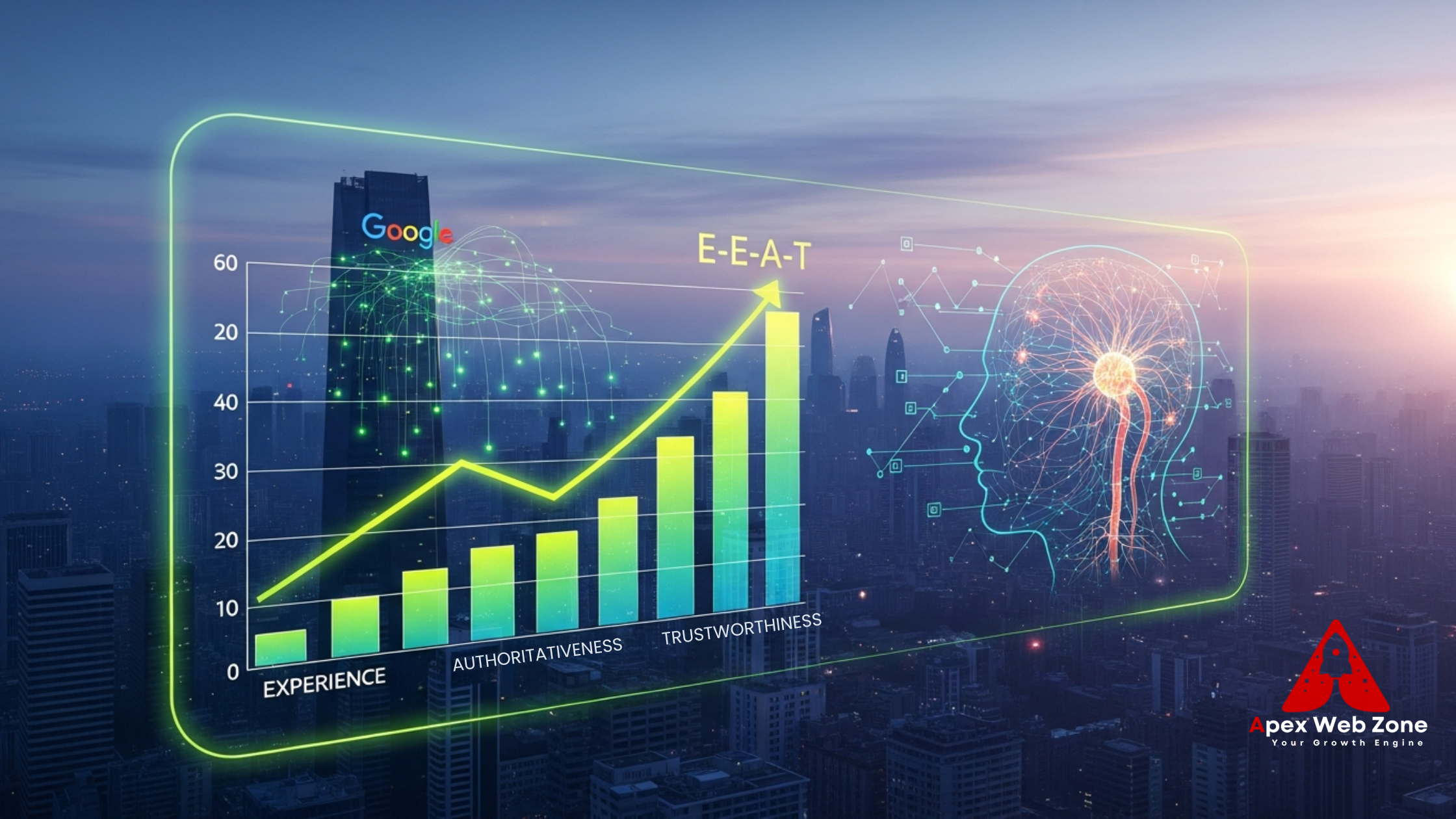
Graphic showing E-E-A-T 2025 and Google’s expertise ranking factors

Search engines evolve fast, but 2025 marks a turning point. For years, brands got away with keyword stuffing, generic blogs, and recycled information. Not anymore. Google now wants something simple but rare: real expertise. And with AI systems analyzing content more aggressively than ever, the brands showing genuine experience are the ones rising to the top.

Whether you operate as a Digital Marketing Agency, Web Design Agency, Website Development Company, or run a global service brand, E-E-A-T has become your new competitive scorecard. It determines who gets visibility, who gets credibility, and who stays buried in the noise.

Why E-E-A-T Matters More In 2025

The explosion of AI-generated content made the web incredibly crowded. Everyone is publishing, but not everyone is qualified. Google needed a filter to highlight trustworthy voices and suppress surface-level content. That filter is E-E-A-T Experience, Expertise, Authoritativeness, Trustworthiness.

In 2025, Google’s systems evaluate not just what you say, but how you say it, why you’re qualified to say it, and whether the internet agrees. Real-world experience now shapes rankings more than keyword frequency. Search engines want the seasoned voice, not the copy-paste version.

For agencies offering PPC Management Services, Custom Web Development, branding, UI/UX, or Shopify SEO Services India, this shift matters. Your visibility depends on your ability to prove you’ve actually done the work.

When E-E-A-T Becomes Crucial

There are moments where E-E-A-T practically decides your position instantly. These moments typically involve decisions that require trust financial planning, business strategies, long-term investments, or specialized services.

A user looking for a Website Development Company or a Digital Marketing Agency isn’t browsing casually. They’re evaluating competence. They’re checking if you understand real problems. They’re trying to feel the confidence behind your words. Google sees this behavior and rewards content written by knowledgeable people rather than generic writers.

Where Brands Fail At E-E-A-T

Most brands fail at E-E-A-T because they oversimplify it. They think Google just wants an author bio or a certification logo. But Google’s quality systems are much sharper. They read tone, depth, clarity, and factual grounding. They recognize the difference between lived experience and empty commentary.

The common failures often look like this :

  • Content that sounds like it was written for everyone, and thus resonates with no one.
  • Advice that reads like a textbook, not like it came from someone who has built campaigns, websites, or strategies.
  • Websites that claim expertise but offer no examples, no results, and no proof.

When a Brand or Design Agency or Web Development Company shares bland, surface-level explanations, Google’s systems instantly recognize the absence of real skill.

How To Actually Build E-E-A-T In 2025

You don’t strengthen E-E-A-T with tricks. You strengthen it with honesty, insight, and real-life learnings things no AI can fabricate convincingly.

The first step is letting your experience show naturally. If you’ve spent years solving technical issues, designing systems, managing ad budgets, creating websites, or helping clients grow, your content should reflect that depth. Walk readers through how you think. Show what you’ve observed. Share how you troubleshoot. That’s the kind of writing Google now loves.

You also strengthen E-E-A-T by allowing real experts to write or contribute. If you have PPC strategists, developers, SEO specialists, designers, or brand consultants, let them speak. You’ll notice your content tone becomes warmer, more natural, and infinitely more trustworthy.

Another important layer is your online reputation. Google tracks mentions, reviews, testimonials, case studies, interviews, and discussions. A respected brand doesn’t need to shout. The industry vouches for it, and Google listens.

And yes, your website matters. A clean, well-crafted platform something a Web Design Agency or Website Development Company would build sends an instant trust signal. Before a user reads a single word, the design already tells them whether your brand is authentic.

How AI Overviews Changed The Meaning Of Authority

AI Overviews have become the new “first gate” for visibility. If Google’s AI doesn’t trust your expertise, your content rarely appears. It’s not just matching keywords it’s evaluating your understanding, experience, and clarity. It’s looking for content that feels like it was written by someone who has solved real problems, not someone who read about them.

This is why agencies offering global services from PPC Management Services to Shopify SEO Services India must create content that reflects real thought. AI rewards content with nuance, insight, and lived understanding. It penalizes content that feels automated or generic.

For brands like Apex Web Zone, rooted in Ahmedabad but serving global clients, E-E-A-T becomes the bridge between local credibility and worldwide recognition. When your expertise feels authentic, geography becomes irrelevant.

Quick Comparison: Old SEO Vs E-E-A-T SEO

Aspect Old SEO New SEO (2025)
Content Style Keyword-Heavy Insight-Heavy
Trust Level Low Requirement Extremely High
Ranking Goal SERP SERP + AI Overview
Proof Needed Minimal Strong And Verifiable
Tone Informative Human, Confident, Practical

What Today’s Users Actually Want

Modern readers don’t want long lectures. They want clarity, calm guidance, and real advice. When someone searches for a Web Design Agency, they aren’t looking for textbook definitions they want someone who understands brand communication, user psychology, and business goals. When they look for a Digital Marketing Agency, they don’t want theory; they want someone who has fought through unpredictable algorithms and still delivered results.

People buy confidence. And confidence comes from experience.

When your content shows that you’ve actually lived the work designed the site, fixed the backend issue, optimized the campaign, or handled the SEO migration you automatically elevate your E-E-A-T signal.

Conclusion: Expertise Isn’t Claimed It’s Proven

E-E-A-T has become the digital world’s truth detector. It allows Google and AI systems to filter real experts from imitators. And in 2025, the brands that succeed are the ones willing to show not tell them why they are qualified.

For service-based companies, including Digital Marketing Agencies, Branding and Design Agencies, and Website Development Companies, this shift is good news. It rewards the people who’ve put in the work, learned through experience, and deliver real value every day.

Apex Web Zone continues to grow its reputation by combining practical experience with strategic thinking, helping businesses build trust in a world where authenticity decides everything. When your knowledge becomes visible, your brand becomes unforgettable.

FAQ's

Q1. What Does E-E-A-T Mean In SEO?

It stands for Experience, Expertise, Authoritativeness, and Trustworthiness Google’s system for deciding which brands deserve visibility.

Q2. Why Is E-E-A-T More Important In 2025?

Because AI systems now judge content quality based on whether the writer has real-world experience. Generic content no longer ranks.

Q3. How Can A Company Improve Its E-E-A-T Score?

By publishing experience-based insights, showcasing case studies, improving author credentials, and strengthening its overall online reputation.

Q4. Does Website Design Play A Role In E-E-A-T?

Definitely. A modern, credible, user-friendly website is part of how users and Google judge trustworthiness.

Q5. Is E-E-A-T Helpful For Global SEO?

Yes. Strong E-E-A-T helps businesses build international credibility while grounding their identity locally.
