
Man stressed at desk looking at declining traffic graph on laptop — organic traffic dropping despite good rankings

You check Google Search Console and everything looks great. Your keywords are sitting on page one. Some are even in the top 3 positions. But when you check your analytics, organic traffic is flat — or worse, it is quietly dropping month after month.

This disconnect between strong rankings and declining traffic is one of the most confusing problems in SEO right now, and it is becoming more common in 2026. In this guide, we break down the hidden reasons why your rankings can look perfectly healthy while your actual visitors disappear — and what you can do to fix it.

The Problem: Rankings Up, Traffic Down

This is the exact scenario many site owners are facing: keyword rankings hold steady or even improve, but click-through traffic from those same keywords steadily declines. It feels counterintuitive — rankings are supposed to be the reward, and traffic is supposed to be the result.

But rankings are only half the equation. A ranking tells you where your page appears in the search results. It says nothing about whether anyone actually clicks through to your site. And in 2026, fewer people are clicking than ever before — even when your page ranks exactly where it used to.

Reason 1: AI Overviews Are Answering the Query Before Users Click

Google’s AI Overviews now appear above traditional search results for a huge range of queries. If your page ranks #1 but Google’s AI Overview already summarizes the answer using your content — or a competitor’s — many users get what they need without ever scrolling down to the organic results.

This is sometimes called a zero-click search. Your ranking position has not changed, but the value of that position has dropped significantly because the search results page itself is now answering the question.

Reason 2: Search Intent Has Shifted, But Your Content Hasn’t

Google constantly re-evaluates what searchers actually want when they type a query. A keyword that used to bring informational traffic might now be dominated by video results, shopping carousels, local map packs, or community discussion threads from forums.

If your page still ranks for the keyword but the layout of the results page has changed around it — with new content types pushed above or alongside your listing — your visibility within that page can shrink dramatically, even if your position number stays the same.

Reason 3: Click-Through Rate Has Quietly Dropped

Rankings are tracked by position, but traffic depends on click-through rate (CTR) at that position. CTR can decline for reasons that have nothing to do with your ranking:

  • Competitors have rewritten their titles and meta descriptions to look more compelling
  • New SERP features (FAQs, images, videos) are pushing your listing further down the visible page, even if your numeric position is unchanged
  • Your title tag no longer matches what users are actually searching for, since search intent evolves over time
  • Branded competitors or large publishers have started ranking above you for the same position range

Search Console shows average position, but it does not always reflect how visible your listing actually is on the page — or how appealing it looks compared to what is now surrounding it.

Reason 4: Seasonal or Demand-Based Search Volume Decline

Sometimes the keyword itself is simply being searched less often. Your ranking position can remain perfectly stable while the total number of people searching that term decreases — meaning your share of a shrinking pie produces fewer total visitors, even though your relative performance hasn’t changed.

This is common with seasonal topics, trending subjects that have cooled off, or older product and service terms being replaced by newer terminology that your content does not yet target.

Reason 5: Cannibalization Between Your Own Pages

If you have multiple pages targeting similar keywords, Google may be alternating which page it shows in results — sometimes ranking Page A, sometimes Page B. Your tracked keyword might show a consistent average position because one of your pages is always ranking, but the actual traffic is being split or redirected between pages in ways that are hard to see in simple rank-tracking tools.

How to Diagnose What’s Really Happening

  • Check Search Console’s Performance report by query and page together. Compare impressions, clicks, and CTR side by side — not just position.
  • Look at SERP features for your target keywords. Search the keyword yourself and note whether AI Overviews, videos, or other features now dominate the page.
  • Review your title tags and meta descriptions. If they were written years ago, they may no longer stand out against newer competitor listings.
  • Check search volume trends. Use a keyword research tool to see if demand for your core terms has dropped over time.
  • Audit for keyword cannibalization. Identify pages on your own site that may be competing with each other for the same queries.

How to Fix Declining Traffic Without Losing Your Rankings

The good news is that fixing this problem rarely means starting over. It usually means refining what you already have.

  • Rewrite title tags and meta descriptions to be more specific, benefit-driven, and aligned with current search intent — this directly impacts CTR without affecting your ranking position.
  • Restructure content to directly and clearly answer the query near the top of the page, which can help you earn placement within AI Overviews rather than being bypassed by them.
  • Add structured data and schema markup so your listing can qualify for rich results like FAQs, star ratings, or sitelinks, which increase visibility on the results page.
  • Consolidate cannibalizing pages into a single, stronger page that consistently ranks instead of splitting authority across multiple URLs.
  • Expand content to cover related questions and subtopics, increasing your chances of capturing additional long-tail queries beyond your original target keyword.

Why This Requires Ongoing Technical and Content Work

Diagnosing a rankings-vs-traffic gap requires a combination of technical SEO, content strategy, and ongoing monitoring — it is rarely a one-time fix. A thorough on-page SEO review can identify whether your titles, headings, and content structure are still aligned with how search results pages look today.

If your content was written some time ago and hasn’t been updated to reflect new search intent or AI-driven result formats, working with a content development process to refresh and restructure key pages can help you recover visibility without losing the rankings you’ve already earned.

For a broader view of how your site is performing across technical, on-page, and visibility factors, a search engine optimization audit can pinpoint exactly where the gap between rankings and traffic is occurring — and prioritize which fixes will have the biggest impact first.

Final Thoughts

Strong rankings used to be the finish line. In 2026, they are just the starting point. The search results page itself has become more crowded, more dynamic, and more likely to answer queries before a click ever happens. If your rankings look great but your traffic is fading, the issue usually isn’t your position — it’s everything around that position that has changed.

If you want a clear picture of why this gap is happening on your site, Apex Web Zone can help you audit your rankings, traffic, and on-page visibility to identify exactly where the disconnect is — and what to fix first.


Rankings measure position only. Traffic depends on click-through rate, search volume, and how the results page itself is structured — all of which can change independently of your ranking position.

AI Overviews are reshaping how users interact with search results, particularly for informational queries. Pages structured to directly and clearly answer questions have a better chance of being referenced within these overviews, which can help offset some of the traffic impact.

There is no fixed schedule, but reviewing them whenever you notice CTR declining — or at least once or twice a year for important pages — helps ensure they still stand out against current competitors.

Thoughtful changes like improving meta descriptions, adding schema, or restructuring content for clarity typically improve or maintain rankings. The risk comes from large structural changes made without a clear plan, which is why a careful audit before making changes is important.

An llms.txt file is placed in your website root and tells AI crawlers what content they can reference. It is part of AXO best practices. While not yet required, implementing it now is a simple step that positions you ahead of competitors. Our WordPress development and Magento development teams can implement this as part of a broader technical SEO package.
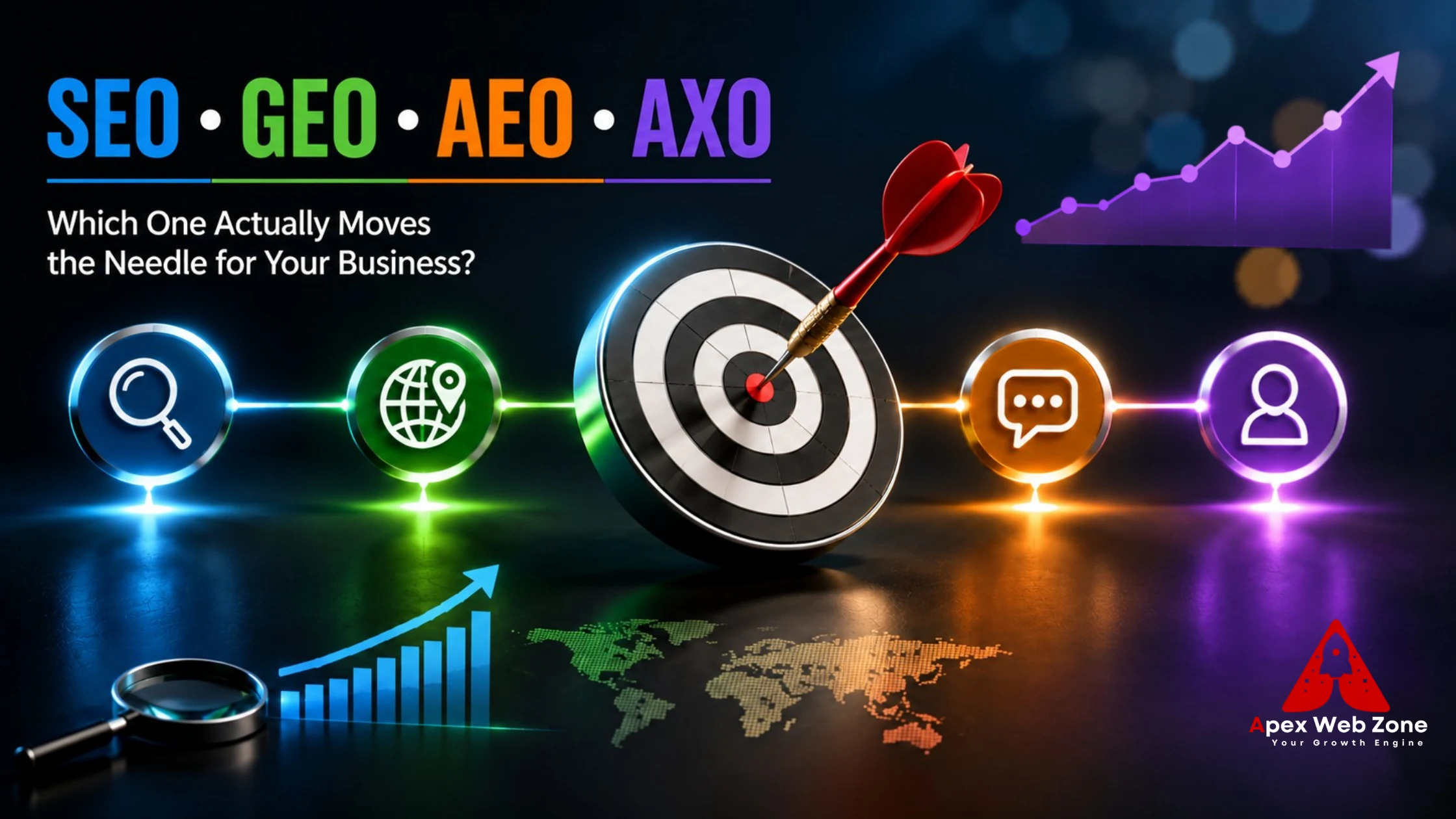

SEO vs GEO vs AEO vs AXO

You’ve heard of SEO. You’ve probably started hearing about GEO. Maybe someone on LinkedIn mentioned AEO or AXO last week and now you’re wondering – do I need all four? Are they replacing each other? Which one should I actually prioritize right now?

This guide cuts through the noise. No fluff, no jargon overload. Just a clear breakdown of what each strategy is, who it’s for, and which one moves the needle for your specific business. If you want expert guidance for your own setup, our 

This is the clearest breakdown you’ll find of all four strategies. And if you want expert help deciding where to start, our SEO services are built exactly for this kind of forward-thinking work.

What Exactly Is SEO? (And Why It Still Matters in 2026)

Search Engine Optimization is the practice of making your website rank higher on Google, Bing, and other traditional search engines. It covers on-page content, technical setup, backlinks, and local presence.

SEO is not dead. Google still handles billions of searches every single day. But the way results are displayed has changed dramatically. AI Overviews, featured snippets, and zero-click answers now sit above the traditional blue links.

This shift is exactly where GEO, AEO, and AXO come in. But without a strong SEO foundation beneath them, none of those three strategies will work. Start with a free SEO audit to understand your current baseline before adding any new layer.

What Is GEO? (Generative Engine Optimization)

GEO – Generative Engine Optimization – is the practice of optimizing your content so that AI-powered answer engines like ChatGPT, Google Gemini, Perplexity, and Claude cite your brand in their responses.

When someone asks an AI chatbot a question, it pulls information from trusted, well-structured sources across the web. GEO is how you become one of those sources.

What GEO focuses on:
  • Building topical authority on specific subjects
  • Earning mentions on high-authority sites, forums, and publications
  • Creating structured, factual, citable content
  • Consistent brand entity signals across the web
  • Getting into AI training data and live retrieval indexes
Who should prioritize GEO?
  • B2B brands wanting to appear in AI-generated buying guides
  • Content publishers and media sites
  • Agencies and consultants building thought leadership – our SEO experts can help you map exactly which publications to target
  • Any business that wants to be the answer, not just a result

Real example: If someone asks ChatGPT “What is the best seo company can do?” – GEO optimization is what puts your brand name in that answer.

What Is AEO? (Answer Engine Optimization)

Answer Engine Optimization is about structuring your content to directly answer specific questions – so search engines and AI systems can extract and display your answer as a featured snippet, voice result, or AI Overview.

AEO predates GEO but is more relevant than ever. Google’s AI Overviews pull heavily from well-structured FAQ content, HowTo schema, and concise paragraph answers.

AEO tactics include:
  • FAQ schema markup on key pages
  • HowTo structured data for process-based content
  • Writing concise 40-60 word direct answers at the top of each section
  • Targeting question-based keywords – what, how, why, best, when
  • Optimizing for voice search and conversational queries
Who should prioritize AEO?
  • Local businesses targeting near-me voice searches
  • Informational sites and knowledge bases
  • E-commerce pages answering product-specific questions
  • Any page targeting featured snippet positions – this ties directly to strong on-page SEO principles

Key difference from GEO: AEO focuses on getting your exact content displayed. GEO focuses on getting your brand cited as a source. Both matter – but they require different content approaches.

What Is AXO? (AI Experience Optimization)

AXO – AI Experience Optimization – is the newest and most technical of the four. It focuses on making your website, product, or content compatible with AI agents, automated tools, and API-driven workflows.

As AI agents like ChatGPT’s browsing mode, Perplexity’s shopping agent, and Google’s Agentic Search begin to take actions on behalf of users – booking, purchasing, comparing, extracting – AXO ensures your platform is visible and usable by these systems.

AXO includes:
  • Structured data that AI agents can parse and act on
  • Clean, machine-readable product and service information
  • API availability and proper documentation
  • llms.txt files to guide AI crawlers
  • Ensuring checkout and conversion flows work in agentic contexts – our WordPress development and Shopify teams handle this technically
Who should prioritize AXO?
  • SaaS platforms and software products
  • E-commerce stores targeting AI shopping agents
  • Travel, finance, and booking platforms
  • Any business where transactions happen online

AXO is the frontier. Most businesses aren’t there yet – but the ones investing in it now will have a significant advantage as agentic AI becomes mainstream in 2026 and beyond.

SEO vs GEO vs AEO vs AXO

Quick comparison of all four optimization strategies

StrategyTargetOutputBest forAI-readyTimeline

SEO

Search Engine Optimization
Google and BingRankingsAll businessesPartial3–6 months

GEO

Generative Engine Optimization
AI answer enginesBrand citationsBrands and publishersYes6–12 months

AEO

Answer Engine Optimization
Voice and featured snippetsDirect answersLocal and informationalYes1–3 months

AXO

AI Experience Optimization
AI agents and APIsActions and dataSaaS and eCommerceFullyOngoing

Which One Moves the Needle for Your Business?

Here’s the honest answer: it depends on where you are in your digital growth journey.

If you’re just starting out – Start with SEO

Before GEO, AEO, or AXO can work, you need a crawlable, indexed, authoritative website. SEO is the foundation. Get your technical basics right, build topical authority, and earn backlinks. Start with a free SEO audit to see exactly where you stand.

If you have SEO basics covered – Add AEO next

Structure your existing content for direct answers. Add FAQ schema. Target question keywords. This is the fastest win after SEO and directly impacts Google AI Overviews and voice search visibility.

If you’re growing a brand – Layer in GEO

Start building your presence on third-party sites, forums, and publications. Create citable, authoritative content. Our SEO experts can build you a GEO outreach plan tailored to your niche.

If you run an online platform or SaaS – Invest in AXO

Prepare your platform for the agentic web. Implement structured data and clean information architecture. Whether you run WordPress, Magento, or Shopify, the technical foundation needs to support fast indexing and clean crawlability.

The Smart Approach: A Layered Strategy

The businesses winning in 2026 aren’t choosing one – they’re stacking all four in the right order:

Layer 1 – SEO: Build the foundation (3-6 months)

Crawlable site, technical basics, keyword-targeted content, backlinks. Everything else depends on this.

Layer 2 – AEO: Capture direct answers (1-3 months)

FAQ schema, HowTo markup, question-keyword content. Fast wins that pay off across Google and AI Overviews.

Layer 3 – GEO: Build brand authority in AI (6-12 months)

Third-party mentions, publication features, citable research. Compounding returns over time.

Layer 4 – AXO: Prepare for the agentic web (Ongoing)

Machine-readable structure, llms.txt, API-friendly pages. The businesses investing here now will dominate in 2027.

Final Thoughts

SEO, GEO, AEO, and AXO are not competing strategies. They are complementary layers of a modern digital presence. SEO gives you the foundation. AEO captures direct answer placements. GEO builds your brand into AI memory. AXO prepares you for the agentic future.
The businesses that treat these as a unified stack – not separate silos – are the ones that will dominate search visibility in 2026 and beyond.
The door is wide open right now. Most competitors haven’t started. If you want to make sure your brand is positioned correctly for both traditional search and AI-driven discovery, our SEO services are built to cover exactly that. Or speak directly with our SEO experts to build a strategy tailored to your goals.


Yes. SEO remains the most important foundation for digital visibility. AI search features are built on top of traditional web indexing – meaning strong SEO directly supports GEO and AEO performance as well. Without it, none of the other three strategies will gain traction.

No. Start with SEO, add AEO once your content library grows, then layer GEO and AXO as your brand matures. Trying to do all four simultaneously without a strong foundation dilutes your effort and slows everything down.

GEO is about getting your brand cited as a trusted source by AI systems. AEO is about getting your specific content displayed as a direct answer. GEO is brand-level. AEO is content-level. They work together but require different tactics.

GEO is a long-term strategy. Expect 6-12 months before you see consistent brand citations in AI-generated responses. However, early signals like brand mentions on authority sites can appear in AI responses within 2-3 months of focused effort.

An llms.txt file is placed in your website root and tells AI crawlers what content they can reference. It is part of AXO best practices. While not yet required, implementing it now is a simple step that positions you ahead of competitors. Our WordPress development and Magento development teams can implement this as part of a broader technical SEO package.