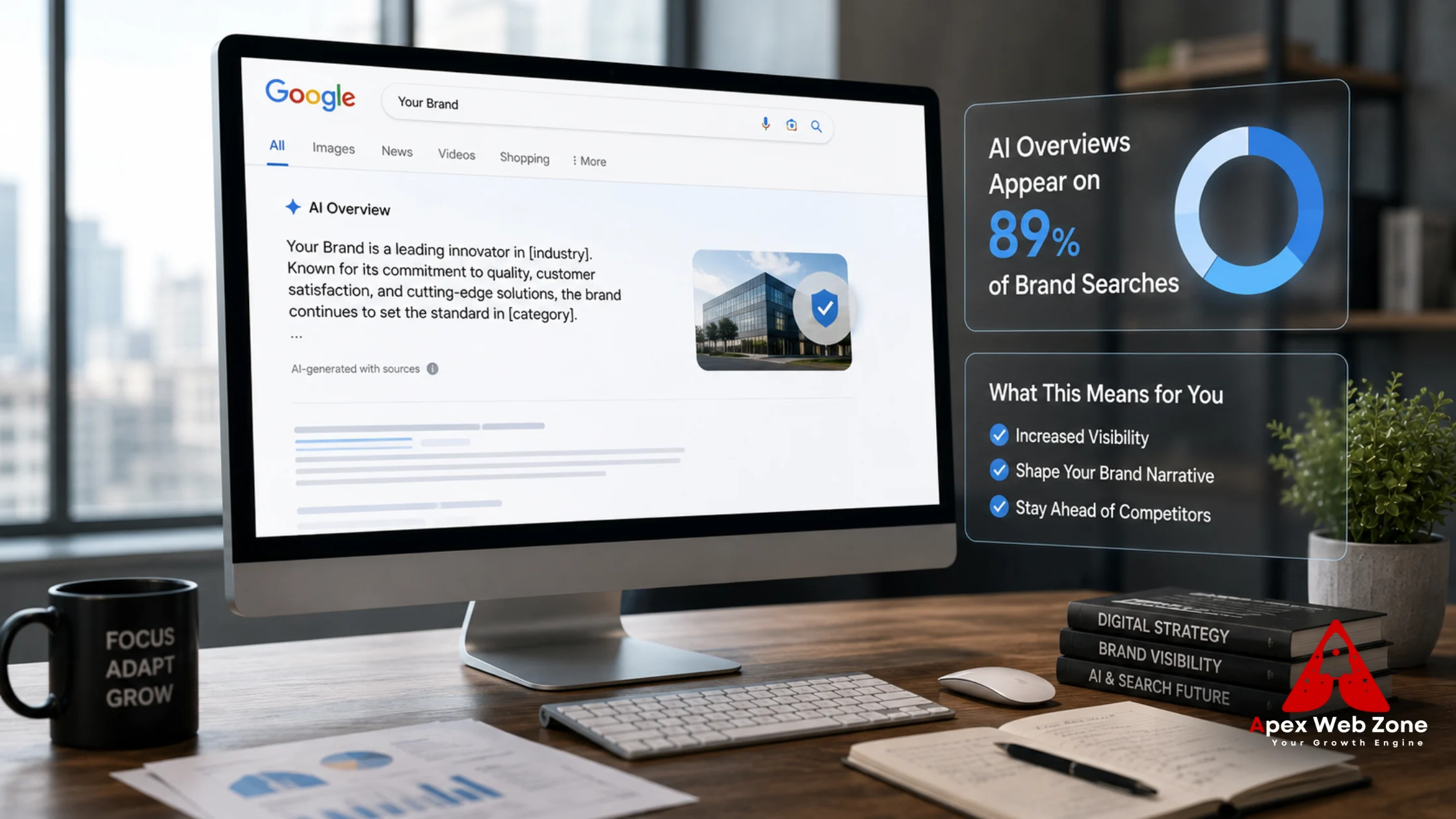
Google AI Overviews Are Showing Up on 89% of Brand Searches — Here Is What That Means for You
If you’ve searched your own brand name on Google lately, you’ve probably noticed something different sitting at the top of the page. Instead of jumping straight to your website, you’re greeted by a neat little AI-written summary first. That’s an AI Overview, and it’s no longer a rare occurrence. Recent tracking shows AI Overviews now appear on the vast majority of brand-name searches, roughly 89% by some estimates, which means almost every time someone types your business name into Google, an AI-generated summary is standing between them and your website.
This shift matters more than most business owners realize. In this article, we’ll break down what’s actually happening, why it’s hitting brand searches so hard, what it means for your traffic, and most importantly, what you can actually do about it.
What’s Actually Happening in the Search Results
Google’s AI Overviews pull together information from multiple sources and generate a short, conversational summary that sits above the traditional list of blue links. Instead of ten websites to click through, a searcher sees one paragraph that tries to answer their question right there on the results page.
When this feature first rolled out, most people assumed it would mainly affect broad, informational searches like “how does compound interest work” or “best running shoes for flat feet.” What’s changed is that it’s now showing up heavily on branded searches too, meaning searches where someone already knows exactly who they’re looking for and types your company name directly into the search bar.
That’s a meaningful shift. A branded search used to be the safest, most predictable traffic a business could count on. Someone searches your name, they land on your homepage, and the journey from there is entirely in your hands. Now, a chunk of that journey starts with an AI-written summary instead.
Why Brand Searches Specifically Are Affected
It’s worth understanding why this is happening, because it changes how you should respond.
Google’s AI systems are trained to satisfy a searcher’s intent as quickly and completely as possible. When someone searches a brand name, Google usually has a lot of well-organized information about that entity already available, things like your website content, business listings, reviews, social profiles, and news mentions. That makes it relatively easy for an AI Overview to stitch together a confident-sounding summary covering who you are, what you do, and what people say about you.
In other words, brand searches are exactly the kind of query AI Overviews are good at answering, because the information is already structured and abundant. The more established your online presence, the easier it is for Google’s systems to summarize you, which is part of why this trend has accelerated so quickly across branded search results.
What This Means for Your Organic Traffic
The honest answer is: it depends on how you show up inside that summary, not just whether it appears.
There’s an important nuance here that gets lost in a lot of the alarming headlines. Branded searches tend to hold up better than generic informational searches when an AI Overview appears. Someone who already typed your exact business name usually has a specific intention, like checking your hours, finding your phone number, or visiting your site directly, and that intent tends to survive the presence of a summary better than a vague research query does.
That said, three things are worth watching closely.
First, your click-through rate on brand searches may soften. If the AI Overview accurately answers a simple question, like your address or your return policy, some searchers won’t feel the need to click through at all.
Second, being cited matters enormously. Businesses that get quoted or linked directly inside the AI Overview tend to see meaningfully better outcomes than businesses whose information gets summarized without a clear citation back to their site.
Third, the summary becomes a first impression. If the AI Overview pulls outdated pricing, an old address, or a review snippet you’d rather not lead with, that’s now shaping how new customers perceive you before they even reach your homepage.
Is This Actually a Bad Thing?
Not entirely, and it’s worth resisting the urge to panic. AI Overviews on brand searches can work in your favor if your online presence is strong, consistent, and well-structured. A searcher who sees an accurate, positive summary of your business, complete with a citation link to your official site, may actually arrive more informed and more ready to convert than someone who had to piece that picture together themselves from five different tabs.
The businesses that struggle here tend to be the ones with messy, inconsistent, or outdated information scattered across the web, think old directory listings, an unclaimed Google Business Profile, or a website that hasn’t been updated in years. AI Overviews don’t create that inconsistency, they just make it a lot more visible, a lot faster.
What You Should Actually Do About It
Here’s where the practical part comes in. None of this requires reinventing your entire marketing strategy, but it does call for a few deliberate adjustments.
- Keep your core brand information consistent everywhere. Your business name, address, phone number, hours, and description should match exactly across your website, Google Business Profile, social media, and any directory listings.
- Use structured data on your website. Schema markup, especially Organization, FAQPage, and Product schema where relevant, gives Google’s systems a clean, machine-readable version of your key facts.
- Strengthen your Google Business Profile. Keep it fully filled out, respond to reviews, and post updates regularly.
- Build a clear, well-organized About and FAQ presence on your own site, so Google’s AI has a strong, accurate source to pull from.
- Monitor what the AI Overview actually says about you. Run searches for your own brand name periodically and correct any outdated or inaccurate information at its source.
- Don’t abandon traditional SEO fundamentals. Fast page speed, clear content, quality backlinks, and genuine expertise still matter.
How to Actually Measure the Impact
Guessing isn’t a strategy, so it’s worth setting up a simple way to track whether AI Overviews are actually changing how people find and click through to your brand.
Start with Google Search Console. Filter your queries to your brand name and variations of it, then compare impressions versus clicks over the past several months. If impressions are holding steady or rising while clicks are slipping, that’s a fairly reliable sign that AI Overviews are absorbing some of that traffic before it reaches your site.
Cross-check with GA4. Look at organic search sessions landing on your homepage and key brand-related pages, segmented by month. A gradual dip here, paired with steady or growing Search Console impressions, tells the same story from a different angle.
Watch your direct and referral traffic too. Sometimes a drop in organic clicks isn’t really a loss, it’s a shift. Some users copy your brand name from an AI Overview citation and type your URL directly, which can show up as direct traffic instead of organic.
None of this needs to be complicated. A simple monthly check of these three data points gives you an honest read on where you actually stand, instead of reacting to headlines or guesswork.
Bringing It All Together
AI Overviews showing up on the overwhelming majority of brand searches is a real shift in how customers first encounter your business online, but it isn’t necessarily a threat if you treat it as a visibility opportunity rather than a traffic-loss problem to panic over. The businesses that come out ahead will be the ones with clean, consistent, well-structured information across the web, the kind of presence that makes it easy for Google’s AI to represent them accurately and link back to the source.
Your job right now isn’t to fight the AI Overview. It’s to make sure that when it summarizes your brand, and it very likely will, it’s telling your story accurately, and pointing people back to you.
Brand searches give Google’s AI a lot of well-organized information to work with, things like your website, business listings, and reviews, which makes it easier for the system to generate a confident summary.
It can, especially for simple questions the summary fully answers. But branded searches tend to hold up better than informational ones, since the searcher usually already intends to visit your site directly.
Compare brand-query impressions and clicks in Google Search Console over several months, and cross-check organic sessions in GA4. Rising impressions with falling clicks is a common sign.
Keep your business name, address, hours, and description consistent everywhere, add structured data like Organization and FAQPage schema, and keep your Google Business Profile complete and current.
They can, especially for simple questions the AI answers directly. But branded searches tend to hold up better than informational ones, since the searcher usually already intends to visit your site.
