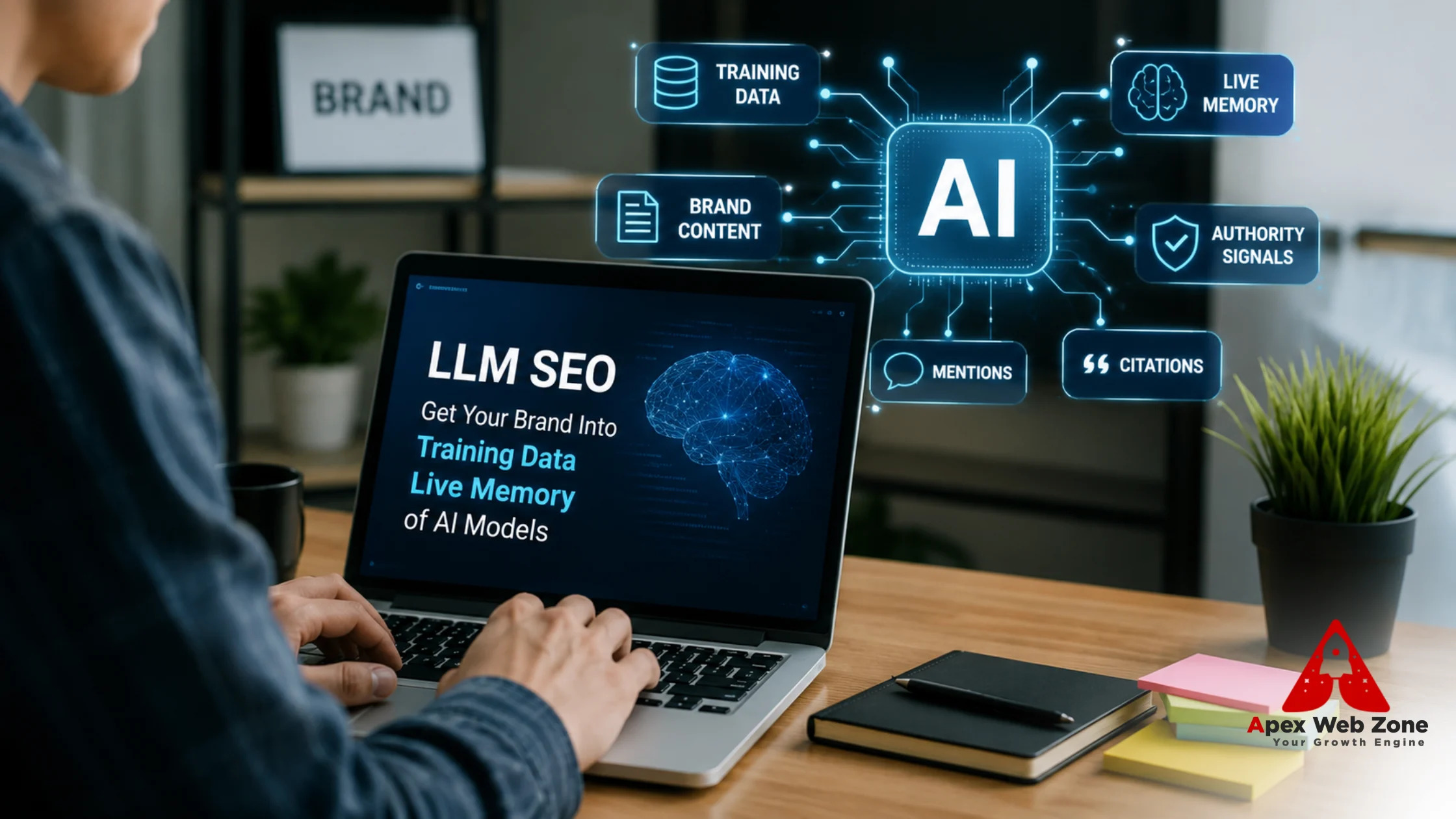
Let me ask you something honest.
When someone asks ChatGPT, “What’s the best digital marketing agency in India?” does your brand show up?
Probably not. And that’s not because your SEO is bad. It’s because traditional SEO was never built for AI.
That’s where LLM SEO comes in.
LLM SEO short for Large Language Model SEO is a completely different game. It’s not about ranking on page one of Google. It’s about getting your brand baked into the actual knowledge of AI tools like ChatGPT, Gemini, Claude, and Perplexity. So when people ask these tools for recommendations, your name comes up naturally.
In this guide, I’ll break down exactly what LLM SEO is, why it matters right now, and what you can do today to start building your brand’s presence inside AI models. If you need expert help along the way, our SEO services are designed exactly for this kind of forward-thinking strategy.
What Exactly Is LLM SEO?
Before we talk strategy, let’s get clear on what we mean.
Traditional SEO is about optimizing your website so Google’s crawlers find it, index it, and rank it. You write content, earn backlinks, fix your technical setup, and hopefully climb the rankings.
LLM SEO is different. AI models like ChatGPT don’t crawl your website in real time. They learned from billions of pieces of content before they were ever launched. That learning process is called training. And the knowledge they picked up? That’s their training data.
So LLM SEO is the practice of making sure your brand, your content, and your expertise end up in that training data or in the live retrieval layer that some AI tools use to look up current information.
Think of it this way. If a student is preparing for an exam, they’ll only mention the books they actually studied. If your brand was never in those books, they can’t mention you.
Why LLM SEO Matters More Than You Think Right Now
Here’s a shift that’s already happening, and most businesses haven’t noticed yet.
People used to Google things. Now they ask AI things.
Instead of typing “best accounting software for small business” into Google and clicking through five links, people are now asking ChatGPT to just give them the answer. And ChatGPT does. It picks two or three brands, explains them briefly, and the conversation ends there.
If your brand isn’t one of those two or three, you don’t just rank lower. You don’t exist in that conversation at all.
That’s the stakes. And here’s the interesting part: right now, most brands aren’t even thinking about this. Which means if you start today, you can get a serious head start. Consider starting with a free SEO audit to understand exactly where your brand stands before you build your LLM SEO strategy.
How AI Models Learn About Brands
Let’s demystify this a bit. How does an AI model actually know about a brand?
There are two main ways:
1. Training Data (Long-Term Memory)
When AI companies train their models, they feed them massive amounts of text from the internet. If your brand was written about in news articles, blog posts, reviews, industry reports, forums, or Wikipedia, there’s a good chance pieces of that content made it into the training data.
The more your brand is mentioned across credible, high-quality sources, the more the AI absorbs that information during training. This builds a kind of long-term memory about who you are.
2. Live Retrieval (Short-Term Memory)
Newer AI tools like Perplexity and Microsoft Copilot also do live web searches when answering questions. They pull in fresh results in real time and use them to generate answers.
This is great news for you. It means even if your brand wasn’t in an AI’s original training data, you can still show up in its live answers. The foundation here is a fast, well-structured website. If you’re on WordPress, our WordPress speed optimization service can help make sure your pages load quickly enough to be favored by live retrieval tools.
7 Proven Strategies to Get Your Brand Into AI Model Memory
Now let’s get practical. Here’s what actually works.
Strategy 1: Build a Wikipedia Presence
Wikipedia is one of the most heavily scraped sources for AI training data. If your brand, founders, or products have a Wikipedia page with solid citations, there’s a strong chance AI models have absorbed that information.
You don’t necessarily need your own Wikipedia page, though that helps if you qualify. You can also work toward being mentioned in relevant Wikipedia articles within your industry. Getting cited in even one well-maintained Wikipedia article puts your brand in front of AI at a very deep level.
Strategy 2: Get Featured in Industry Publications
AI training data heavily favors content from authoritative, well-known sources like Forbes, HubSpot, Search Engine Journal, Moz, and similar high-credibility websites.
Getting your brand featured, quoted, or mentioned in these publications through guest posts, expert quotes, press coverage, or case studies dramatically increases the chances of your brand being included in an AI’s training snapshot. Our SEO experts can help you identify and target the right publication outreach opportunities for your niche.
Strategy 3: Dominate the Answer Engine Layer
AI tools with live retrieval pull their answers from web pages. This means if your content consistently appears in featured snippets, FAQ boxes, and position-zero results on Google, these AI tools will pull from you. This is closely tied to strong on-page SEO principles.
Structure your content to directly answer questions. Use clear headings. Write concise definitions. Add FAQ sections. This increases the likelihood that AI retrieval systems grab your answer and cite your page.
Strategy 4: Use Structured Data and Schema Markup
Schema markup helps AI understand what your content is about at a deeper level. By tagging your pages with structured data like Organization schema, Article schema, FAQPage schema, and HowTo schema, you make your content machine-readable. If you need technical help implementing this, our WordPress development and Magento development teams handle schema implementation as part of our technical SEO work.
AI crawlers and search bots prioritize well-structured content. The clearer your signal, the more likely your brand’s information gets captured accurately during any training or retrieval process.
Strategy 5: Build a Consistent Brand Mention Footprint
AI models learn about brands partly from how often and where they’re mentioned. If your brand name appears across many different credible contexts like Twitter threads, Reddit discussions, LinkedIn articles, podcast transcripts, and niche forum posts, the AI builds a stronger association with your brand identity.
This is sometimes called a brand mention footprint. It’s not just about backlinks. It’s about volume and variety of your brand mentions across the web. Pairing this with local SEO gives your brand a strong regional footprint that AI tools can recognize when users ask location-based questions.
Strategy 6: Create Deeply Cited, Original Research
Original research like surveys, data reports, case studies, and industry benchmarks gets cited heavily by other websites. And when other websites cite your research, your brand name spreads across the web in a credible, authoritative context.
AI training datasets love this kind of content because it’s factual, specific, and widely referenced. If you run an eCommerce store, combining original research with eCommerce SEO gives you a powerful combination of AI visibility and organic search traffic.
Strategy 7: Keep a Clean, Consistent Brand Entity
AI models recognize brands as entities. For your brand to be understood clearly, it needs to look consistent everywhere including your website, Google Business Profile, LinkedIn, Crunchbase, and everywhere else.
Inconsistency confuses AI models the same way it confuses search engines. This is one reason we always recommend starting with a free SEO audit before launching any AI visibility campaign. It gives us a clear picture of how your brand currently appears across the web.
A Quick Note on “Live Memory” vs. “Training Memory”
Here’s a distinction worth understanding before you build your strategy.
Training memory is fixed. Once a model is trained, what it learned is locked in until the next training cycle. You can’t update it in real time. That’s why a brand that existed before 2023 might be better known to ChatGPT than a brand that launched last month.
Live memory is dynamic. Tools like Perplexity and Copilot actively search the web during each conversation. Your fresh content, new press releases, and recent blog posts can influence these tools today, not six months from now.
The smartest LLM SEO strategy covers both angles. Build content that earns citations for future training cycles, and publish consistently so you stay visible in real-time retrieval. Whether your site runs on WordPress, Shopify, or Magento, the technical foundation needs to support fast indexing and clean crawlability.
What NOT to Do with LLM SEO
A few things that won’t work, so you don’t waste time:
- Don’t try to “prompt inject” AI models. Some people try to game AI outputs by embedding hidden instructions in their content. This doesn’t work and goes against platform policies.
- Don’t publish low-quality content at scale. AI models are trained to recognize authority and quality. Thin content won’t earn citations and won’t help your training data presence.
- Don’t ignore your own website. Your site is still the foundation. A fast, well-structured, credible website is what live retrieval tools pull from. If site speed is a concern, our WordPress performance optimization service is a great place to start.
- Don’t expect overnight results. LLM SEO is a compounding strategy. Months of consistent effort build a presence that becomes very hard to displace.
Where to Start If You’re New to This
If you’re just getting started and feeling overwhelmed, here’s the simplest possible path:
- Audit your brand entity. Search your brand name on ChatGPT, Gemini, and Perplexity. See what they say. Note what’s wrong or missing.
- Get a free SEO audit to understand your current technical and content baseline before building your AI visibility strategy.
- Write one long-form, question-answering piece of content that directly addresses your target audience’s biggest questions.
- Add schema markup to your top service pages and blog posts. If you need help, our SEO experts can handle this end to end.
- Track your AI citation status monthly. Note when AI tools start mentioning you, and document which content triggered it.
LLM SEO doesn’t require a massive budget. It requires consistency, quality, and patience.
Final Thoughts
The way people find information is changing faster than most businesses realize.
Five years ago, the goal was to rank on page one of Google. Today, the goal is to be the answer that AI gives before someone even visits a search engine. That shift is already happening. Brands that move now will be the ones AI talks about naturally. If you want to make sure your brand is positioned correctly for both traditional search and AI-driven discovery, our SEO services are built to cover exactly that.
LLM SEO isn’t the future. It’s the present. And right now, the door is wide open.
FAQ's
Regular SEO is about ranking your website on Google’s search results page. LLM SEO is about getting your brand known and remembered by AI language models like ChatGPT, Gemini, and Claude. Regular SEO depends on crawling and indexing by search engines. LLM SEO depends on what went into an AI model’s training data and how well your content shows up when AI tools search the web in real time.
Not directly into its past training, no. But there are two ways you can still show up. First, by building enough presence across the web that you are included when OpenAI runs its next training cycle. Second, by producing content that ranks well and gets picked up by AI tools that use live retrieval. Starting with a free SEO audit helps you identify exactly where your content gaps are.
It depends on which layer you are targeting. For live retrieval tools like Perplexity, results can show up within weeks if your content ranks well and answers questions clearly. For being included in a model’s training data, it can take much longer because AI companies retrain their models on a set schedule. The key is to start now and build consistently.
Yes, significantly. Wikipedia is one of the most widely used sources in AI training datasets because it is factual, neutral, and regularly updated. Having a Wikipedia page about your brand, or even just being mentioned and cited in relevant Wikipedia articles, greatly increases the chances that AI models will have accurate information about your brand in their training memory.
Content that is factual, well-sourced, and answers specific questions performs best. This includes long-form explainer articles, original research reports, expert interview content, detailed how-to guides, and FAQ pages. Avoid thin content or anything that reads as filler. If you want a structured content plan built around LLM SEO principles, hire our SEO experts to put together a strategy tailored to your brand.
