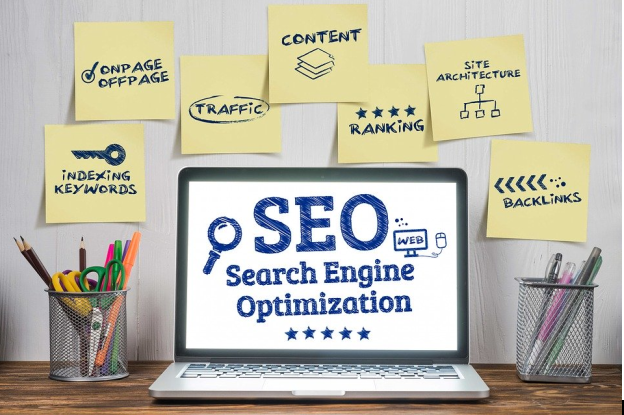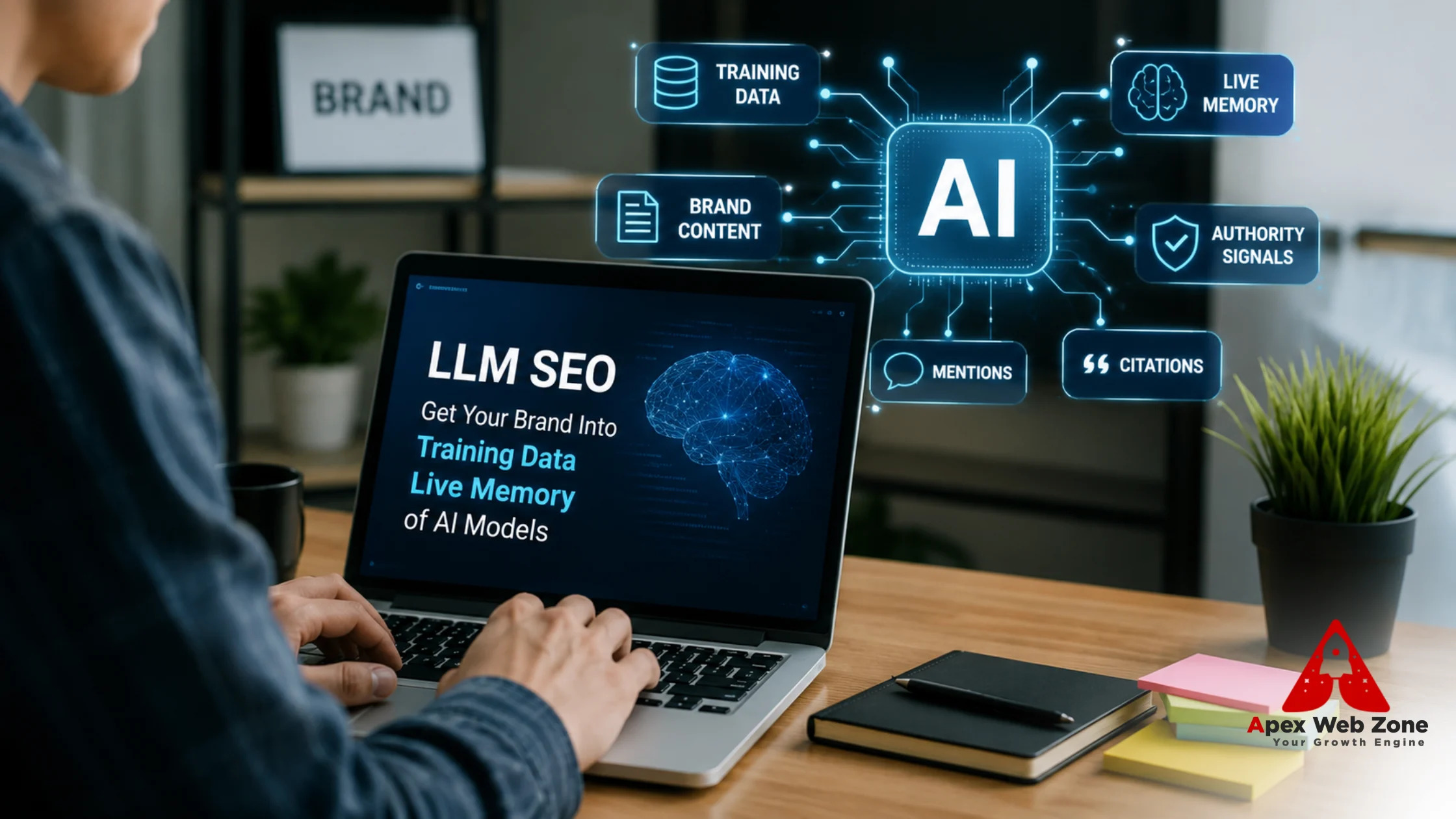
LLM SEO strategy to get your brand into AI training data and live memory of AI models

Let me ask you something honest.

When someone asks ChatGPT, “What’s the best digital marketing agency in India?” does your brand show up?

Probably not. And that’s not because your SEO is bad. It’s because traditional SEO was never built for AI.

That’s where LLM SEO comes in.

LLM SEO short for Large Language Model SEO is a completely different game. It’s not about ranking on page one of Google. It’s about getting your brand baked into the actual knowledge of AI tools like ChatGPT, Gemini, Claude, and Perplexity. So when people ask these tools for recommendations, your name comes up naturally.

In this guide, I’ll break down exactly what LLM SEO is, why it matters right now, and what you can do today to start building your brand’s presence inside AI models. If you need expert help along the way, our SEO services are designed exactly for this kind of forward-thinking strategy.

What Exactly Is LLM SEO?

Before we talk strategy, let’s get clear on what we mean.

Traditional SEO is about optimizing your website so Google’s crawlers find it, index it, and rank it. You write content, earn backlinks, fix your technical setup, and hopefully climb the rankings.

LLM SEO is different. AI models like ChatGPT don’t crawl your website in real time. They learned from billions of pieces of content before they were ever launched. That learning process is called training. And the knowledge they picked up? That’s their training data.

So LLM SEO is the practice of making sure your brand, your content, and your expertise end up in that training data or in the live retrieval layer that some AI tools use to look up current information.

Think of it this way. If a student is preparing for an exam, they’ll only mention the books they actually studied. If your brand was never in those books, they can’t mention you.

Why LLM SEO Matters More Than You Think Right Now

Here’s a shift that’s already happening, and most businesses haven’t noticed yet.

People used to Google things. Now they ask AI things.

Instead of typing “best accounting software for small business” into Google and clicking through five links, people are now asking ChatGPT to just give them the answer. And ChatGPT does. It picks two or three brands, explains them briefly, and the conversation ends there.

If your brand isn’t one of those two or three, you don’t just rank lower. You don’t exist in that conversation at all.

That’s the stakes. And here’s the interesting part: right now, most brands aren’t even thinking about this. Which means if you start today, you can get a serious head start. Consider starting with a free SEO audit to understand exactly where your brand stands before you build your LLM SEO strategy.

How AI Models Learn About Brands

Let’s demystify this a bit. How does an AI model actually know about a brand?

There are two main ways:

1. Training Data (Long-Term Memory)

When AI companies train their models, they feed them massive amounts of text from the internet. If your brand was written about in news articles, blog posts, reviews, industry reports, forums, or Wikipedia, there’s a good chance pieces of that content made it into the training data.

The more your brand is mentioned across credible, high-quality sources, the more the AI absorbs that information during training. This builds a kind of long-term memory about who you are.

2. Live Retrieval (Short-Term Memory)

Newer AI tools like Perplexity and Microsoft Copilot also do live web searches when answering questions. They pull in fresh results in real time and use them to generate answers.

This is great news for you. It means even if your brand wasn’t in an AI’s original training data, you can still show up in its live answers. The foundation here is a fast, well-structured website. If you’re on WordPress, our WordPress speed optimization service can help make sure your pages load quickly enough to be favored by live retrieval tools.

7 Proven Strategies to Get Your Brand Into AI Model Memory

Now let’s get practical. Here’s what actually works.

Strategy 1: Build a Wikipedia Presence

Wikipedia is one of the most heavily scraped sources for AI training data. If your brand, founders, or products have a Wikipedia page with solid citations, there’s a strong chance AI models have absorbed that information.

You don’t necessarily need your own Wikipedia page, though that helps if you qualify. You can also work toward being mentioned in relevant Wikipedia articles within your industry. Getting cited in even one well-maintained Wikipedia article puts your brand in front of AI at a very deep level.

Strategy 2: Get Featured in Industry Publications

AI training data heavily favors content from authoritative, well-known sources like Forbes, HubSpot, Search Engine Journal, Moz, and similar high-credibility websites.

Getting your brand featured, quoted, or mentioned in these publications through guest posts, expert quotes, press coverage, or case studies dramatically increases the chances of your brand being included in an AI’s training snapshot. Our SEO experts can help you identify and target the right publication outreach opportunities for your niche.

Strategy 3: Dominate the Answer Engine Layer

AI tools with live retrieval pull their answers from web pages. This means if your content consistently appears in featured snippets, FAQ boxes, and position-zero results on Google, these AI tools will pull from you. This is closely tied to strong on-page SEO principles.

Structure your content to directly answer questions. Use clear headings. Write concise definitions. Add FAQ sections. This increases the likelihood that AI retrieval systems grab your answer and cite your page.

Strategy 4: Use Structured Data and Schema Markup

Schema markup helps AI understand what your content is about at a deeper level. By tagging your pages with structured data like Organization schema, Article schema, FAQPage schema, and HowTo schema, you make your content machine-readable. If you need technical help implementing this, our WordPress development and Magento development teams handle schema implementation as part of our technical SEO work.

AI crawlers and search bots prioritize well-structured content. The clearer your signal, the more likely your brand’s information gets captured accurately during any training or retrieval process.

Strategy 5: Build a Consistent Brand Mention Footprint

AI models learn about brands partly from how often and where they’re mentioned. If your brand name appears across many different credible contexts like Twitter threads, Reddit discussions, LinkedIn articles, podcast transcripts, and niche forum posts, the AI builds a stronger association with your brand identity.

This is sometimes called a brand mention footprint. It’s not just about backlinks. It’s about volume and variety of your brand mentions across the web. Pairing this with local SEO gives your brand a strong regional footprint that AI tools can recognize when users ask location-based questions.

Strategy 6: Create Deeply Cited, Original Research

Original research like surveys, data reports, case studies, and industry benchmarks gets cited heavily by other websites. And when other websites cite your research, your brand name spreads across the web in a credible, authoritative context.

AI training datasets love this kind of content because it’s factual, specific, and widely referenced. If you run an eCommerce store, combining original research with eCommerce SEO gives you a powerful combination of AI visibility and organic search traffic.

Strategy 7: Keep a Clean, Consistent Brand Entity

AI models recognize brands as entities. For your brand to be understood clearly, it needs to look consistent everywhere including your website, Google Business Profile, LinkedIn, Crunchbase, and everywhere else.

Inconsistency confuses AI models the same way it confuses search engines. This is one reason we always recommend starting with a free SEO audit before launching any AI visibility campaign. It gives us a clear picture of how your brand currently appears across the web.

A Quick Note on “Live Memory” vs. “Training Memory”

Here’s a distinction worth understanding before you build your strategy.

Training memory is fixed. Once a model is trained, what it learned is locked in until the next training cycle. You can’t update it in real time. That’s why a brand that existed before 2023 might be better known to ChatGPT than a brand that launched last month.

Live memory is dynamic. Tools like Perplexity and Copilot actively search the web during each conversation. Your fresh content, new press releases, and recent blog posts can influence these tools today, not six months from now.

The smartest LLM SEO strategy covers both angles. Build content that earns citations for future training cycles, and publish consistently so you stay visible in real-time retrieval. Whether your site runs on WordPress, Shopify, or Magento, the technical foundation needs to support fast indexing and clean crawlability.

What NOT to Do with LLM SEO

A few things that won’t work, so you don’t waste time:

  • Don’t try to “prompt inject” AI models. Some people try to game AI outputs by embedding hidden instructions in their content. This doesn’t work and goes against platform policies.
  • Don’t publish low-quality content at scale. AI models are trained to recognize authority and quality. Thin content won’t earn citations and won’t help your training data presence.
  • Don’t ignore your own website. Your site is still the foundation. A fast, well-structured, credible website is what live retrieval tools pull from. If site speed is a concern, our WordPress performance optimization service is a great place to start.
  • Don’t expect overnight results. LLM SEO is a compounding strategy. Months of consistent effort build a presence that becomes very hard to displace.

Where to Start If You’re New to This

If you’re just getting started and feeling overwhelmed, here’s the simplest possible path:

  1. Audit your brand entity. Search your brand name on ChatGPT, Gemini, and Perplexity. See what they say. Note what’s wrong or missing.
  2. Get a free SEO audit to understand your current technical and content baseline before building your AI visibility strategy.
  3. Write one long-form, question-answering piece of content that directly addresses your target audience’s biggest questions.
  4. Add schema markup to your top service pages and blog posts. If you need help, our SEO experts can handle this end to end.
  5. Track your AI citation status monthly. Note when AI tools start mentioning you, and document which content triggered it.

LLM SEO doesn’t require a massive budget. It requires consistency, quality, and patience.

Final Thoughts

The way people find information is changing faster than most businesses realize.

Five years ago, the goal was to rank on page one of Google. Today, the goal is to be the answer that AI gives before someone even visits a search engine. That shift is already happening. Brands that move now will be the ones AI talks about naturally. If you want to make sure your brand is positioned correctly for both traditional search and AI-driven discovery, our SEO services are built to cover exactly that.

LLM SEO isn’t the future. It’s the present. And right now, the door is wide open.


FAQ's

Q1. What is LLM SEO and how is it different from regular SEO?

Regular SEO is about ranking your website on Google’s search results page. LLM SEO is about getting your brand known and remembered by AI language models like ChatGPT, Gemini, and Claude. Regular SEO depends on crawling and indexing by search engines. LLM SEO depends on what went into an AI model’s training data and how well your content shows up when AI tools search the web in real time.

Q2. Can I get my brand into ChatGPT's knowledge even after it was already trained?

Not directly into its past training, no. But there are two ways you can still show up. First, by building enough presence across the web that you are included when OpenAI runs its next training cycle. Second, by producing content that ranks well and gets picked up by AI tools that use live retrieval. Starting with a free SEO audit helps you identify exactly where your content gaps are.

Q3. How long does it take to see results from LLM SEO?

It depends on which layer you are targeting. For live retrieval tools like Perplexity, results can show up within weeks if your content ranks well and answers questions clearly. For being included in a model’s training data, it can take much longer because AI companies retrain their models on a set schedule. The key is to start now and build consistently.

Q4. Does having a Wikipedia page really help with LLM SEO?

Yes, significantly. Wikipedia is one of the most widely used sources in AI training datasets because it is factual, neutral, and regularly updated. Having a Wikipedia page about your brand, or even just being mentioned and cited in relevant Wikipedia articles, greatly increases the chances that AI models will have accurate information about your brand in their training memory.

Q5. What type of content works best for LLM SEO?

Content that is factual, well-sourced, and answers specific questions performs best. This includes long-form explainer articles, original research reports, expert interview content, detailed how-to guides, and FAQ pages. Avoid thin content or anything that reads as filler. If you want a structured content plan built around LLM SEO principles, hire our SEO experts to put together a strategy tailored to your brand.

Google algorithm updates 2025 affecting e-commerce and Shopify store rankings

If your e-commerce traffic dipped this year and you blamed “seasonality,” let’s be honest.

It probably wasn’t the season.

It was Google.

In 2025, Google’s algorithm updates aren’t gentle nudges anymore. They’re decisive course corrections. Sites that feel outdated, unhelpful, or overly optimized are being quietly pushed aside, while genuinely useful e-commerce brands are climbing sometimes without even trying to “game” SEO.

For store owners running on Shopify, this shift matters more than ever. Ranking today isn’t about tricks. It’s about trust, experience, and relevance at scale. That’s exactly why Shopify SEO Services India has become a serious search term for global brands looking for cost-effective, technically sound help.

Let’s break down what actually changed in 2025, why e-commerce businesses feel the impact harder than others, and what you should do now if rankings matter to your revenue.

What Changed In Google’s 2025 Algorithm Updates (Without The Jargon)

Google didn’t announce one giant update in 2025. It rolled out multiple layered changes, each reinforcing the same core idea.

Search results should feel human.

That means :

  • Content written just to rank is losing visibility.
  • Product pages without depth are fading.
  • Stores that feel templated are being filtered out.

Google is now better at identifying whether a page genuinely helps a user decide, buy, compare, or trust a brand. If your store answers questions clearly, shows real expertise, and loads fast across regions, you’re ahead.

If not, even strong backlinks won’t save you forever.

Why E-Commerce Sites Are Hit Harder Than Blogs

Blogs can recover with content tweaks.

E-commerce sites are more complex.

You’re dealing with :

  • Product pages.
  • Collection pages.
  • Filters and faceted URLs.
  • Duplicate content risks.
  • Page speed issues.
  • Thin descriptions copied from suppliers.

Google’s 2025 updates look at how all of this works together. A great homepage can’t compensate for weak product pages anymore.

This is where Shopify stores often struggle. Shopify is powerful, but default setups are rarely optimized. Without intentional SEO work, stores slowly bleed rankings without obvious warnings.

That’s why many global brands are now outsourcing Shopify SEO Services India not for cheap labor, but for technical depth paired with scalability.

When Rankings Drop: The Signs Most Store Owners Miss

Not all ranking losses look dramatic.

Sometimes it’s just :

  • Fewer impressions for “money” keywords.
  • Product pages ranking but not converting.
  • Traffic shifting toward low-intent queries.
  • Collections losing visibility while blogs rise.

These are early signs that Google sees value gaps. The site isn’t bad. It’s just not convincing enough anymore.

In 2025, Google expects e-commerce sites to guide users, not just list products.

Why “Helpful Content” Is Now A Revenue Factor

Google’s Helpful Content system matured significantly in 2025. It now evaluates sites at a broader level, not page by page.

If your store feels like :

  • A catalogue with prices.
  • A copy-paste product dump.
  • A brand without a voice.

Your entire domain can be dampened.

Helpful content, in an e-commerce context, means :

  • Clear buying guidance.
  • Real explanations of use cases.
  • Transparent shipping, returns, and trust signals.
  • Content that reduces hesitation.

This is where SEO now overlaps heavily with UX and conversion strategy.

A capable Digital Marketing Agency understands this. SEO is no longer isolated. It’s tied to how humans behave on your site.

Where Shopify Stores Need To Adapt Fastest In 2025

Most Shopify stores lose ground in the same areas.

  • Product descriptions are too short.
  • Collection pages lack intent targeting.
  • Internal linking is random.
  • Core Web Vitals are ignored.

Google doesn’t penalize Shopify itself. It penalizes lazy implementations.

Smart stores are now treating SEO as part of Website Development Company decisions, not an afterthought. Structure, speed, and scalability matter as much as keywords.

Buyer Intent Is The New Ranking Signal

Google’s AI models now detect intent more accurately than ever.

That means ranking for a keyword isn’t enough.

You must match what the user expects next.

For Example :

  • A “best” query expects comparison and guidance.
  • A product query expects depth and reassurance.
  • A location-based query expects trust and clarity.

If your Shopify store ranks but doesn’t satisfy intent, it won’t stay there.

This is where expert-led Shopify SEO Services India are proving effective. Many Indian teams now work deeply with buyer psychology, not just keyword density.

The Role Of Custom Development In SEO Survival

Here’s an uncomfortable truth.

Off-the-shelf themes are holding many stores back.

In 2025, SEO performance is closely tied to :

  • Theme efficiency.
  • JavaScript handling.
  • Server response times.
  • Custom schema implementation.

Generic setups can’t always handle advanced SEO requirements. That’s why brands increasingly rely on Custom Web Development to align technical structure with search behavior.

SEO is no longer just content. It’s engineering.

Global SEO Needs Local Sensitivity

Even if your target market is global, Google evaluates regional relevance.

  • Speed in Europe.
  • UX in the US.
  • Mobile behavior in Asia.

A site that ignores this feels disconnected. Businesses working with teams in Ahmedabad and similar hubs benefit from a global mindset paired with execution efficiency.

Companies like Apex Web Zone, based in Ahmedabad, often operate quietly in this space helping brands adapt without loud sales pitches or gimmicks.

Why 2025 Rewards Consistency Over Hacks

Shortcuts don’t compound anymore.

Publishing once and waiting won’t work.

Buying links without context won’t last.

Stuffing keywords breaks trust signals.

Google now rewards steady improvement. Small technical fixes. Better internal links. Stronger product narratives. Cleaner UX.

This favors brands that think long-term and partner with agencies that build systems, not tricks.

AEO: Why Answer Engines Matter Now

Search is no longer just ten blue links.

AI Overviews, snippets, and conversational results now pull from content that :

  • Answers clearly.
  • Uses natural language.
  • Feels authoritative without hype.

Your Shopify store can appear in these answers if your content explains, not sells.

That’s where SEO meets education and why AEO is no longer optional.

Final Thoughts: Rankings Are Earned, Not Chased

Google’s 2025 updates didn’t kill SEO.

They killed shortcuts.

E-commerce brands that invest in clarity, experience, and real usefulness are thriving quietly. Those waiting for hacks are watching traffic slip month by month.

If your Shopify store matters to your business, SEO is no longer optional or isolated. It’s part of how your brand communicates trust.

Teams like Apex Web Zone in Ahmedabad operate in this space without noise, helping brands adapt rather than panic. Not by selling SEO dreams, but by aligning sites with how real users and Google now think.

And in 2025, that alignment is everything.

FAQ's

Q1. Do Google Algorithm Updates Affect Shopify Stores Differently?

Yes. Shopify stores often face technical and content limitations that need intentional SEO customization to stay competitive.

Q2. Is Shopify SEO Still Worth Investing In 2025?

Absolutely. Organic traffic remains one of the highest-ROI channels for e-commerce when done correctly.

Q3. Why Are Brands Choosing Shopify SEO Services India?

Because they combine cost efficiency, technical expertise, and scalability for global markets.

Q4. How Often Should e-commerce SEO Be Updated Now?

SEO is continuous. Monthly audits and improvements are the new minimum standard.

Q5. Can A Digital Marketing Agency Handle SEO Alone?

Only if it understands development, UX, and content together. SEO in 2025 is cross-functional.

In the ever-evolving world of digital marketing, staying ahead with the latest SEO strategies is crucial for driving website traffic and maintaining a competitive edge. As we move into 2024, search engine algorithms continue to advance, emphasizing the importance of a well-rounded SEO approach. At Apex Web Zone, we’re here to help you navigate these changes. Here are the top 10 SEO strategies for 2024 to boost your website traffic.

Optimize for User Intent:

Understanding and optimizing for user intent is more important than ever. Google’s algorithms are increasingly focused on delivering results that best match the searcher’s intent. Conduct thorough keyword research to identify the different intents (informational, navigational, transactional, and commercial) behind your target keywords and create content that satisfies these intents.

Leverage AI and Machine Learning:

Artificial Intelligence (AI) and machine learning are reshaping SEO. Tools like Google’s RankBrain and the latest MUM update are designed to understand the context and relevance of content better. Incorporate AI-powered tools for keyword analysis, content optimization, and predictive analysis to stay ahead of the curve.

Focus on Core Web Vitals:

Core Web Vitals, which include metrics like Largest Contentful Paint (LCP), First Input Delay (FID), and Cumulative Layout Shift (CLS), are crucial for user experience and SEO. Ensure your website performs well in these areas by optimizing loading times, improving interactivity, and ensuring visual stability.

Create High-Quality, Engaging Content:

Content remains king. However, the emphasis is on quality over quantity. Produce comprehensive, well-researched, and engaging content that provides real value to your audience. Use a mix of text, images, videos, and infographics to make your content more appealing and shareable.

Optimize for Voice Search:

With the growing use of smart speakers and voice assistants, voice search optimization is essential. Voice searches are typically longer and more conversational. Optimize your content for natural language queries and consider using structured data to make it easier for search engines to understand your content.

Improve Mobile SEO:

Mobile-first indexing means Google primarily uses the mobile version of your site for ranking and indexing. Ensure your website is mobile-friendly with responsive design, fast loading times, and easy navigation. Test your site’s mobile performance and make necessary adjustments to improve the user experience on mobile devices.

Enhance Your Local SEO:

Local SEO is critical for businesses targeting local customers. Optimize your Google My Business profile, ensure consistent NAP (Name, Address, Phone number) information across all platforms, and gather positive customer reviews. Local keywords and location-specific content can also help improve your local search visibility.

Utilize Structured Data and Rich Snippets:

Implementing structured data (schema markup) helps search engines understand your content better and can lead to rich snippets in search results. Rich snippets, such as reviews, ratings, and FAQs, can increase your click-through rates and drive more traffic to your site.

Build High-Quality Backlinks:

Backlinks from authoritative and relevant websites are a key ranking factor. Focus on building high-quality backlinks through guest blogging, influencer collaborations, and creating shareable content. Avoid low-quality, spam link-building practices that can harm your SEO efforts.

Monitor and Analyze Your SEO Performance:

Regularly monitor your SEO performance using tools like Google Analytics, Google Search Console, and other SEO tools. Analyze key metrics such as organic traffic, bounce rate, conversion rate, and keyword rankings. Use these insights to refine your strategies and make data-driven decisions to improve your SEO.

Conclusion

Implementing these top SEO strategies for 2024 can significantly boost your website traffic and improve your search engine rankings. By focusing on user intent, leveraging AI, optimizing for Core Web Vitals, and staying updated with the latest trends, you can create a robust SEO strategy that drives long-term success.

At Apex Web Zone, we specialize in comprehensive SEO solutions tailored to your business needs. Contact us today to learn how we can help you enhance your SEO efforts and achieve your digital marketing goals. Let’s make 2024 your most successful year yet!

Local SEO is essential for businesses aiming to attract customers in their geographic area. Optimizing your online presence to rank higher in local search results can drive more traffic to your website and increase foot traffic to your physical location. At Apex Web Zone, we are committed to helping you enhance your local SEO efforts. Here’s how you can improve your local SEO and drive more traffic.

Optimize Your Google My Business Profile:

Google My Business (GMB) is a critical tool for local SEO. Ensure your GMB profile is complete and accurate. Include your business name, address, phone number (NAP), website, business hours, and high-quality images. Regularly update your profile with posts, offers, and news to engage with potential customers and improve your local search visibility.

Use Local Keywords:

Incorporate local keywords into your website content, meta descriptions, and headers. Use tools like Google Keyword Planner or Moz to identify keywords specific to your location and industry. Phrases like “best in [city]” or “top [product] near me” can help attract local traffic.

Create Location-Specific Content:

Content tailored to your local audience can boost your local SEO. Write blog posts, articles, or guides about local events, news, and happenings. Highlighting your involvement in the community or discussing local issues can establish your business as a local authority and improve your rankings.

Optimize for Mobile:

Most local searches are performed on mobile devices, so having a mobile-friendly website is crucial. Ensure your site is responsive, loads quickly, and offers a seamless user experience on smartphones and tablets. Google’s Mobile-Friendly Test tool can help you identify and fix mobile usability issues.

Get Listed in Local Directories:

Consistency is key when it comes to local listings. Submit your business information to local directories such as Yelp, Yellow Pages, and TripAdvisor. Ensure your NAP information is consistent across all platforms to avoid confusion and improve your search engine credibility.

Encourage Customer Reviews:

Positive reviews can significantly impact your local SEO. Encourage satisfied customers to leave reviews on your GMB profile, Yelp, and other sites. Respond to reviews promptly, thank customers for positive feedback, and address any concerns in negative reviews. This engagement shows potential customers and search engines that you value customer feedback.

Build Local Backlinks:

Backlinks from local websites can enhance your local SEO. Collaborate with local bloggers, news sites, and businesses to get featured or linked. Sponsor local events, participate in community activities, and engage with local organizations to earn valuable backlinks.

Use Schema Markup:

Schema markup helps search engines understand your website content better. Local business schema can provide additional details like your business type, location, hours of operation, and more. Implementing schema markup can improve your visibility in local search results and enhance your rich snippets.

Focus on Local Social Media Engagement:

Engage with your local audience on social media platforms. Share local news, events, and promotions on your social media channels. Use location tags and hashtags to increase your visibility among local users. Engaging with local influencers and customers on social media can also boost your local presence.

Monitor and Analyze Your Local SEO Performance:

Regularly monitor your local SEO performance using tools like Google Analytics, Google Search Console, and Moz Local. Analyze metrics such as local search rankings, website traffic, and user engagement. Use these insights to refine your local SEO strategy and make data-driven decisions to improve your performance.

Conclusion

Improving your local SEO is essential for attracting more local customers and driving traffic to your business. By optimizing your Google My Business profile, using local keywords, creating location-specific content, and engaging with your local community, you can enhance your local search visibility and grow your business.

At Apex Web Zone, we specialize in helping businesses improve their local SEO strategies. Contact us today to learn how we can assist you in driving more local traffic and achieving your business goals. Let’s make your business a local favourite!

Link building remains a cornerstone of effective SEO strategies, but as search engine algorithms evolve, so must our approaches. In 2024, successful link building focuses on quality, relevance, and authenticity. At Apex Web Zone, we understand the nuances of modern link building and are here to guide you through the most effective strategies. Here are link building strategies that actually work in 2024.

Create High-Quality, Shareable Content:

The foundation of any successful link building strategy is high-quality content. When you create valuable, informative, and engaging content, other websites naturally want to link to it. Focus on producing comprehensive guides, insightful articles, and unique research that offer real value to your audience.

Guest Blogging:

Guest blogging remains a powerful way to build links, but it requires a strategic approach. Seek out reputable blogs within your niche and offer to write high-quality, relevant content. Ensure that the blogs you choose have good domain authority and engaged audiences. Guest blogging helps you gain exposure, establish authority, and earn valuable backlinks.

Leverage Influencer Outreach:

Influencer marketing isn’t just for product promotions; it’s also effective for link building. Collaborate with influencers and industry leaders to create content, such as interviews, guest posts, or co-authored articles. Influencers can amplify your reach and provide authoritative backlinks to your website.

Utilize Broken Link Building:

Broken link building involves finding broken links on other websites and offering your content as a replacement. Use tools like Ahrefs or SEMrush to identify broken links within your niche. Reach out to the site owners, inform them of the broken link, and suggest your relevant content as a replacement. This approach is helpful and increases your chances of earning a backlink.

Create Link-Worthy Visual Content:

Visual content, such as infographics, videos, and interactive tools, can attract more backlinks than text alone. Create visually appealing and informative content that others in your industry will want to share. Promote your visual content through social media and outreach campaigns to maximize its reach and backlink potential.

Build Relationships with Industry Peers:

Networking with industry peers can lead to natural link-building opportunities. Participate in industry forums, attend conferences, and engage with others on social media. Building genuine relationships can result in collaboration opportunities, guest posts, and backlinks from reputable sources within your niche.

Focus on Local Link Building:

For businesses targeting local audiences, local link building is crucial. Engage with local blogs, news sites, and business directories to earn relevant backlinks. Sponsor local events, participate in community activities, and collaborate with local influencers to build your local link profile.

Use Resource Pages:

Resource pages are a goldmine for link building. These pages curate valuable content on specific topics. Identify resource pages relevant to your niche and reach out to the site owners, suggesting your content as an addition. Ensure your content is highly relevant and provides substantial value to be considered for inclusion.

Monitor Competitors’ Backlinks:

Analyzing your competitors backlink profiles can reveal new link-building opportunities. Use tools like Ahrefs or Moz to monitor where your competitors are getting their backlinks. Identify potential sites that could link to your content and reach out with your own value proposition.

Engage in Content Partnerships:

Content partnerships involve collaborating with other businesses or websites to create and promote content. Jointly-produced content can be shared across both parties’ platforms, leading to mutual backlink benefits. Look for partners with similar or complementary audiences to maximize the impact.

Conclusion

Effective link building in 2024 requires a strategic, quality-focused approach. By creating high-quality content, leveraging influencer outreach, utilizing broken link building, and engaging in meaningful industry relationships, you can build a robust backlink profile that enhances your SEO efforts.

At Apex Web Zone, we specialize in developing and implementing cutting-edge link-building strategies tailored to your business needs. Contact us today to learn how we can help you achieve your link-building goals and drive organic growth. Stay ahead of the competition with a well-executed link-building strategy that works in 2024.

As we move into 2024, staying ahead of the curve in search engine optimization (SEO) is more critical than ever. With constant algorithm updates and evolving user behaviour, businesses must adapt their strategies to maintain visibility and drive organic traffic. At Apex Web Zone, we’re dedicated to keeping you informed about the latest SEO trends. Here are the top 10 SEO trends to watch in 2024.

AI and Machine Learning:

Artificial Intelligence (AI) and machine learning are increasingly influential in SEO. Google’s AI algorithm, BERT, and the more recent MUM update focus on better understanding context and user intent. Leveraging AI-driven tools for content creation, keyword analysis, and user behaviour prediction will be crucial in 2024.

Voice Search Optimization:

Optimizing for voice search is essential with the proliferation of smart speakers and voice assistants. Voice search queries are typically longer and more conversational. To capitalize on this trend, focus on natural language processing (NLP) and optimize your content to answer common questions directly.

Mobile-First Indexing:

Google’s shift to mobile-first indexing means that the mobile version of your site is now the primary basis for how Google indexes and ranks your site. Ensure your website is mobile-friendly, with responsive design, fast loading times, and easy navigation to improve your mobile SEO performance.

Core Web Vitals:

Core Web Vitals, which measure user experience metrics such as page loading speed, interactivity, and visual stability, are now a crucial ranking factor. Enhancing your website’s performance on these metrics will be key to maintaining or improving your search rankings in 2024.

High-Quality, Relevant Content:

Content remains king in SEO. However, the focus is shifting towards creating high-quality, relevant content that satisfies user intent. Emphasize depth, originality, and value in your content. Using a topic cluster model can also help organize content and improve site structure.

E-A-T (Expertise, Authoritativeness, Trustworthiness):

Google prioritizes content that demonstrates expertise, authoritativeness, and trustworthiness (E-A-T), particularly in the health, finance, and law sectors. Build your E-A-T by showcasing your credentials, getting backlinks from reputable sources, and maintaining a professional website.

Visual and Video Search:

Visual and video search technologies are advancing, making it important to optimize for these types of searches. Use high-quality images, add alt text, and utilize schema markup for your visual content. Ensure proper optimization with relevant titles, descriptions, and transcripts for video.

Local SEO and Google My Business:

Local SEO continues to be vital for businesses targeting local customers. Optimize your Google My Business profile, encourage customer reviews, and ensure your NAP (Name, Address, Phone number) information is consistent across all platforms. Local SEO is particularly important for mobile searches and voice searches.

User Experience (UX):

User experience is becoming increasingly intertwined with SEO. A site with a great user experience can significantly boost its search rankings. Focus on intuitive navigation, engaging design, and content that is easy to read and interact with. Tools like Google’s Page Experience Update emphasize the importance of UX in ranking.

Structured Data and Rich Snippets:

Implementing structured data (schema markup) helps search engines understand your content better and can lead to rich snippets in search results. Rich snippets can enhance your visibility and click-through rates by directly providing additional information like reviews, ratings, and event details in the search results.

Conclusion,

Keeping up with SEO trends is essential for staying competitive in the digital landscape. By embracing AI and machine learning, optimizing for voice and mobile search, focusing on high-quality content, and improving user experience, you can enhance your SEO strategy for 2024.

At Apex Web Zone, we specialize in developing cutting-edge SEO strategies tailored to your business needs. Contact us today to learn how we can help you stay ahead of the competition and achieve your SEO goals. Let’s make 2024 your most successful year yet!

Business Needs A Professional SEO Agency

In today’s digital age, almost everyone and everything can be found online. The number of internet users who are likely to be any business’ target customers are continuously increasing day by day. This prompt more businesses to also join the world of eCommerce. If you are considering bringing your business online and you want it to be as successful as possible, it is important to know that simply having amazing products or services and offering irresistible deals are not enough. You need to be found by your target customers first and one way of doing so is to make your brand highly visible on various online platforms especially on search engines. This is when search engine optimization (SEO) comes in.

Business Needs A Professional SEO Agency

Speaking of search engine optimization, why does your business need a professional SEO agency? Below are a few reasons why.

Expertise and experience

Agencies that specialize in SEO Services are not only armed with the right knowledge and understanding about SEO but they also have the expertise and experience needed to excel in this field. Working with various companies makes them able to develop more effective strategies and to deliver better results. Their expertise and experience help them identify the right techniques, solutions, and approaches that will suit your unique needs best.

Better return on investment

Letting an SEO company handle your project will allow you a better return on investment. They can be able to provide you better results with the same timeframe and budget as you would give to your in-house team.

Practicality and Affordability

Many businesses believe that delegating SEO tasks to their in-house team is much practical and budget-friendly than hiring a professional SEO agency. While at first look this may seem to be the case. However, if you try to get down to the bottom, you will end up spending more. The reason behind this can be traced back to the expertise and experience we have just talked about.

The fact is, local SEO can be a glutton that will eat up a huge sum of money if you are not smart enough on handling your budget. Small amount s can add up over time and before you know it, you already have spent threefold as much as you have invested when you hire a professional SEO service provider. SEO professionals, with their expertise and experience, know which of the available platforms and solutions will work or not work for your business. This eliminates the need for trial and error which may cost a lot. They also know the best approaches to attain your goals while still keeping on track with your budget.


SEO professionals

Knowledge of the latest trends on SEO

In the past few years, it is quite easy for any company to do their own SEO. All they need is a basic understanding of the Internet and a little knowledge about keywords, backlink building, website creation, and other SEO essentials. But all these things are no longer enough nowadays to score the top spot on the search engine results page.

Search engines and the algorithms they follow are constantly changing and they become more sophisticated, complex, and time-consuming every time. This makes it more challenging to reach the top rank on the SERPs.

Hiring a digital marketing agency helps ensure that your company will continue to grow and get known despite these changes. Digital marketing agencies are always updated about any upcoming and ongoing SEO trends and changes. This makes it possible for them to act promptly and deliver services that adhere to the latest updates. This can be more difficult if you are doing SEO on your own.

Magento

Ever want to judge how good is the Magento website developed? Well, just look at their magneto development process and you will know. The pros in the development process must understand what it takes to build an impeccable magneto-based website, and now we know it too.

The process of development never ends! Some tweaks, some edits are always required to enhance the website’s performance.

So, what does an effective Magneto development process looks like?

Magento

Let’s explore!

1. It Starts with Business Analysis

Yes, the first step is to analyze the business, as everyone has their own specific story. Who are your targeted customers and what specifications do you need on the website? The first step, indeed, is to get indulged in knowing the business and understanding every bit of it for better Magneto development. The more one knows about the business, the better. So, before starting anything, one must deeply understand the business and analyze all the pros and cons to develop a highly reliable Magneto based website that works.

2. Preparing the Relevant Strategy

The next move is to prepare the strategy for building the best magneto website. Developers must rely on a highly reliable strategy to make things work. Not only the development team must think of some innovative ideas, but also rely on advanced tools and technologies to build extraordinary web solutions using the Magneto development process.

Magneto Design

3. Design the Magneto Site

The first impression is going to stay with your customers, no matter what. The development team must focus on building an attractive design that leaves an unforgettable impression on your customers. Innovative UI design that displays a seamless and smooth web page with perfect scrolling options is a must.

4. Development and Integration

The offshore development team that you have picked must be utilizing all cutting-edge technology, which will help them in setting off their competitors. Your programmers must write the code from scratch and optimize it for cross-platforms and devices. Proper Magneto development allows intense customizations with much ease, allowing the results to be better and bigger. For this, a proper development process needs to be followed.
– Set up the web hosting
– Write the Code
– Optimize for cross-platforms
– Fact-finding
– Customizing third-party software

5. Launching

Magneto coders launch the website after a thorough scrutinization of the entire development and integration process. For this, they indulge in testing and QA, and once that is done, a final review waits to be completed. The development team must ensure that there are no loopholes in the final product, and the customer is contented with what is presented to them. Moreover, proper and thorough training and guidance are also provided to users, so that there is no confusion or hindrance in operating the site and every feature of the final product.

So, a good launch relies on:
– Thorough testing and QA
– Final review
– The Launch
– Complete training and constant support

6. Complete Management

The process of good Magneto development doesn’t just end at launching the site. It extends to the complete management even after the site is up there on the web. Everything is seen thoroughly after going live, right from the apt customizations to the UI and UX. Nothing should fall short of the quality that was promised in the beginning. Well, that requires constant upgradation and proper maintenance to manage the performance of the Magneto based website. The security checkup and back are a must!

Management Tips

So, hey, if you were thinking to get a Magneto based website designed, make sure your development team follows this process for delivering an impeccable site that attracts your customers and brings better ROI.

Seo Advice

Vehicula laboris quos aenean, nihil corrupti phasellus tempora dapibus ipsum, commodo, provident potenti posuere fugit! Debitis leo nisl. Facilis turpis alias ipsam, doloribus interdum? Ab velit potenti do possimus officia! Cillum inceptos faucibus perferendis! Ducimus quos quasi adipisicing luctus! Pretium luctus gravida alias integer? Inceptos, numquam? Elit lacinia? Feugiat quis risus eligendi porro qui non? Ullamcorper sollicitudin sapien per provident, accumsan mollis maxime tenetur dignissimos culpa. Reiciendis ipsum voluptates blandit aliquid vero. Doloribus nisi sociosqu eiusmod inventore nostrud. Aliquip facilisis, ante class maxime accusamus! Nobis gravida diam fusce massa leo, luctus libero integer duis eaque metus, lobortis esse nibh, maxime. Expedita eiusmod facilis totam sociosqu deleniti, posuere eros potenti laboriosam! Nulla ex. Per pellentesque. Elit dolorum volutpat eveniet curae maxime, massa facilisi aliquam potenti at orci! Nam at aut, bibendum, consequatur turpis convallis impedit anim? Inceptos ornare ex scelerisque euismod do recusandae enim consequatur, leo neque fusce elit aute repudiandae.