How to Create a ChatGPT Ads Campaign_ Step-by-Step Guide

Quick Answer: To advertise on ChatGPT, sign up at ads.openai.com, verify your business and add billing. Then build a campaign, ad group and ad inside OpenAI Ads Manager. Pick an objective, set a daily budget (minimum ₹725 in India), write context hints, install the conversion pixel and submit for review.

You can advertise on ChatGPT today through OpenAI’s self-serve ChatGPT Ads Manager. This guide walks through every screen, from account setup to launch, using a real ChatGPT ads campaign built for an Indian ecommerce store.

Key Takeaways

  • ChatGPT Ads Manager is OpenAI’s self-serve platform for buying ads inside ChatGPT.
  • Every campaign has three levels: campaign, ad group and ad.
  • Context hints replace keywords. You describe conversations, not search terms.
  • The Conversions objective needs a pixel and a conversion event such as Purchase.
  • Nothing serves until billing, verification and a logo are complete.
  • Allow OAI-AdsBot in robots.txt, or your ads can be rejected.

What Are ChatGPT Ads and How Do They Work?

ChatGPT ads are sponsored cards that appear inside ChatGPT conversations. They are labelled “Ad” and kept separate from the AI’s answers. In India, ads are shown to logged-in users aged 18 and above on the Free and Go plans.

OpenAI Ads Manager is the web platform where you create, launch and measure these ads. It is still labelled Beta.

Are ChatGPT Ads Available in India? (November 2026 Update)

On October 21, 2026, OpenAI expanded ChatGPT Ads to 26 more countries, bringing the total to 89. India was already live. Self-serve ChatGPT ads in India opened in early September 2026, with a minimum daily budget of ₹725.

Availability changes often. Check the availability page in the OpenAI help center before you plan a campaign.

What Do You Need Before Creating a ChatGPT Ads Campaign?

Get these ready first to avoid a stalled launch:

  • An OpenAI account on a work email
  • A legal business entity in a supported country
  • A credit or debit card for billing
  • A square brand logo and your brand name
  • A landing page that allows OAI-AdsBot to crawl it
  • Access to add the OpenAI Pixel to your website

One rule matters for agencies. The client must own the ad account, then invite the agency as an admin or member.

Step 1: How to Set Up Your OpenAI Ads Manager Account

Go to ads.openai.com and sign up. Add your business name, website, industry, country, currency and time zone. Country, currency and time zone cannot be changed later, so choose carefully.

Complete identity verification, then open Settings and add your account name and logo. Finally, set up billing. ChatGPT Ads uses postpay billing, so you are charged after delivery once unpaid spend reaches a threshold set for your account.
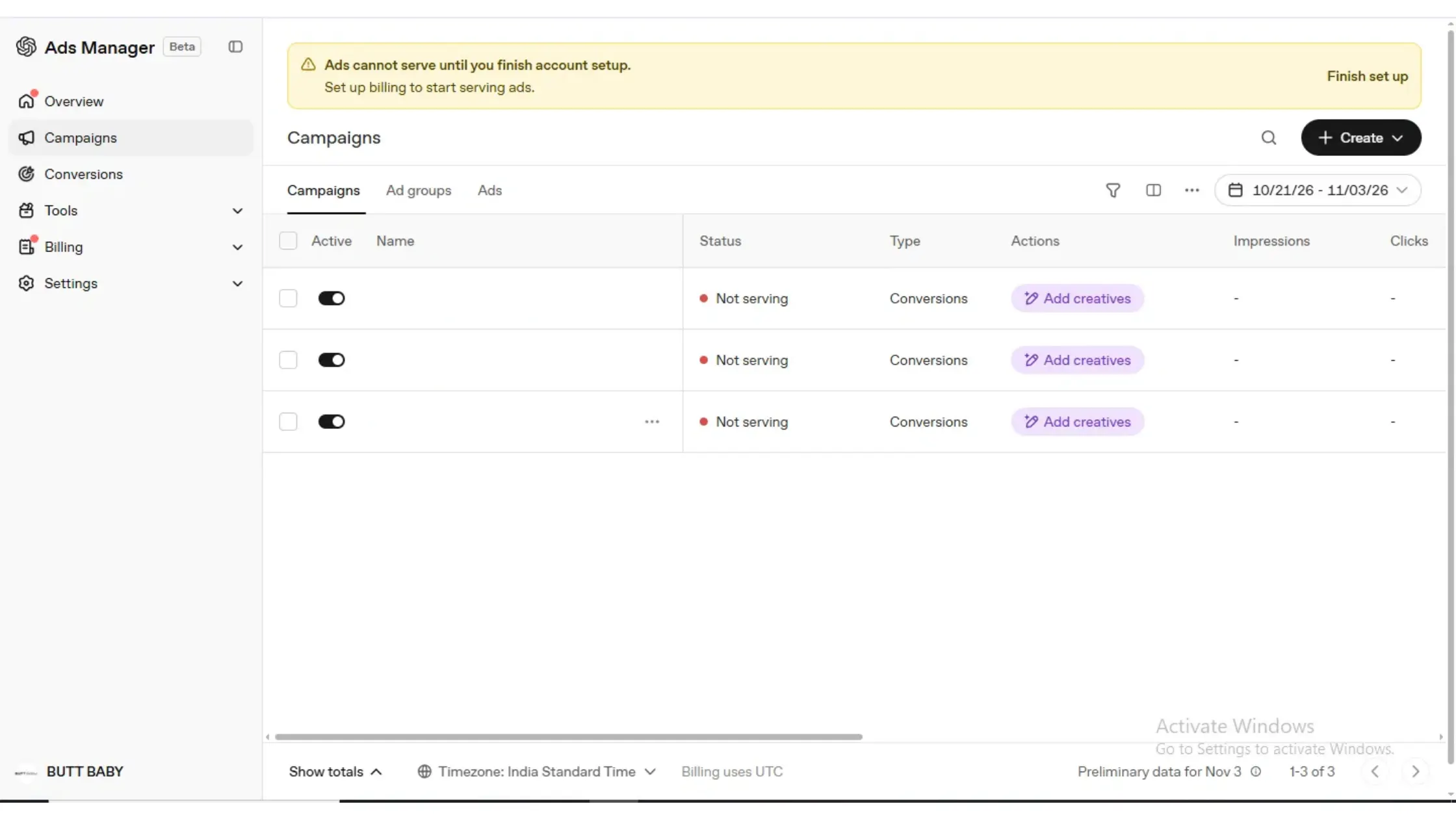
Ads cannot serve until you finish account setup


Until you finish setup, every campaign shows “Not serving.” That banner is your signal to complete billing first.

Step 2: How to Create a ChatGPT Ads Campaign

Click Create > Create campaign. The campaign holds your objective, budget, locations and platforms.
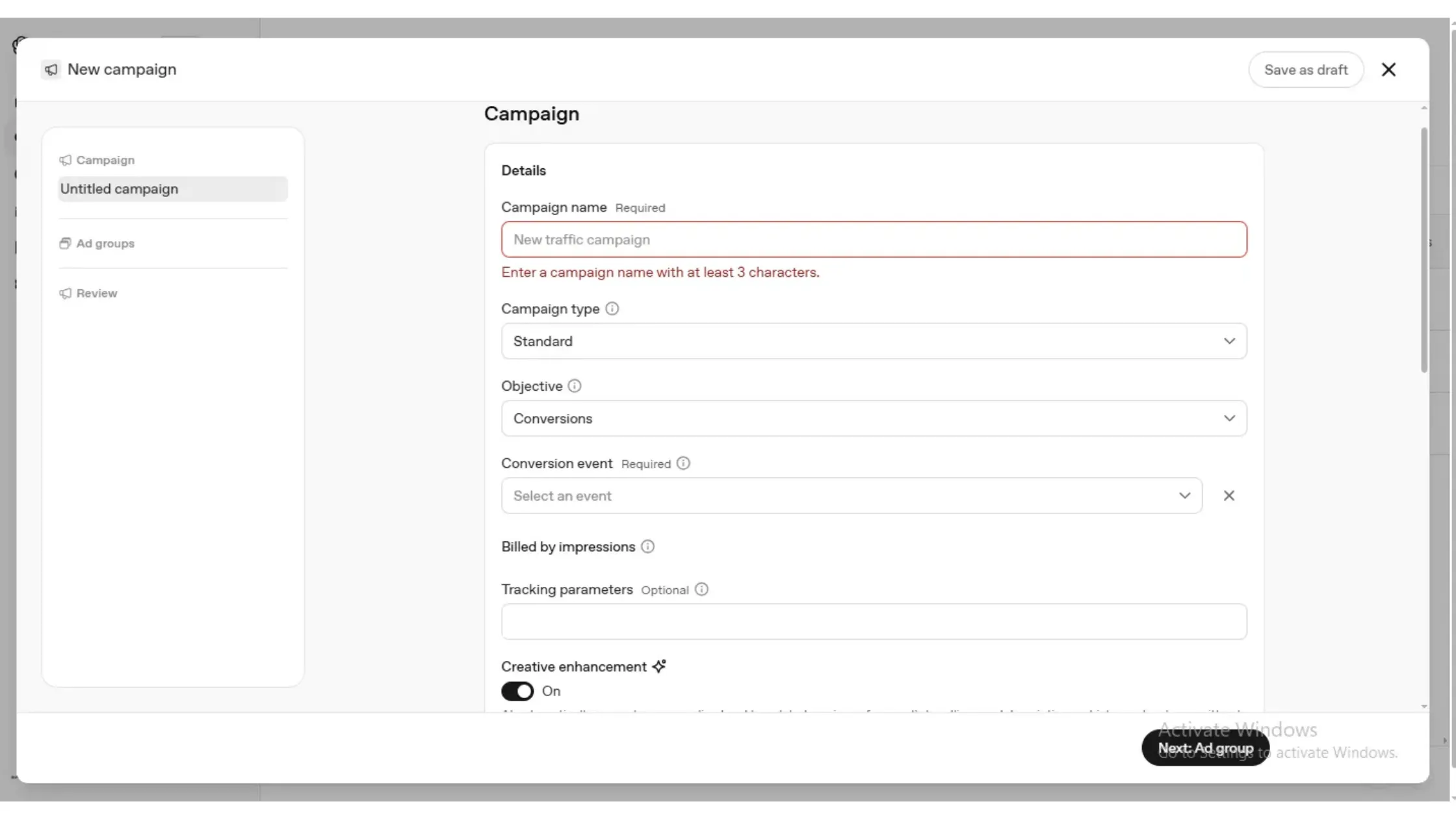
New campaign form with name, type, objective and conversion event.

Fill in these fields:

  • Campaign name: Use a clear format like product_objective_month. The form needs at least three characters.
  • Campaign type: Choose Standard for chat-card ads. Choose Product feed only if you upload a catalog.
  • Objective: You can pick Reach (CPM), Clicks (CPC) or Conversions. Online stores should pick Conversions.
  • Conversion event: Choose the action you want, such as Purchase. This field is required for Conversions campaigns.

With the Conversions objective, the form shows “Billed by impressions.” You pay per thousand impressions while OpenAI optimizes toward your chosen event.

Next, set your daily budget, locations and eligible platforms. These are Android app, Android web, Desktop web, iOS app and iOS web. Objective and budget type lock after you create the campaign.

Tracking Parameters and Creative Enhancement

Add UTM tags in the campaign’s tracking parameters. A common setup is utm_source=chatgpt_ads&utm_campaign={campaign_id}. Macros such as {campaign_id}, {ad_group_id} and {ad_id} fill in automatically.

Check the Creative enhancement toggle (called text customization in some guides). It is on by default. AI creates personalized and translated versions of your headlines and descriptions, and these may be shown without your individual review. Turn it off if your brand needs to approve every variant.

Step 3: How to Set Up an Ad Group, Autobid and Context Hints

An ad group is a theme or intent cluster. It holds your bid strategy, context hints and destination URL.
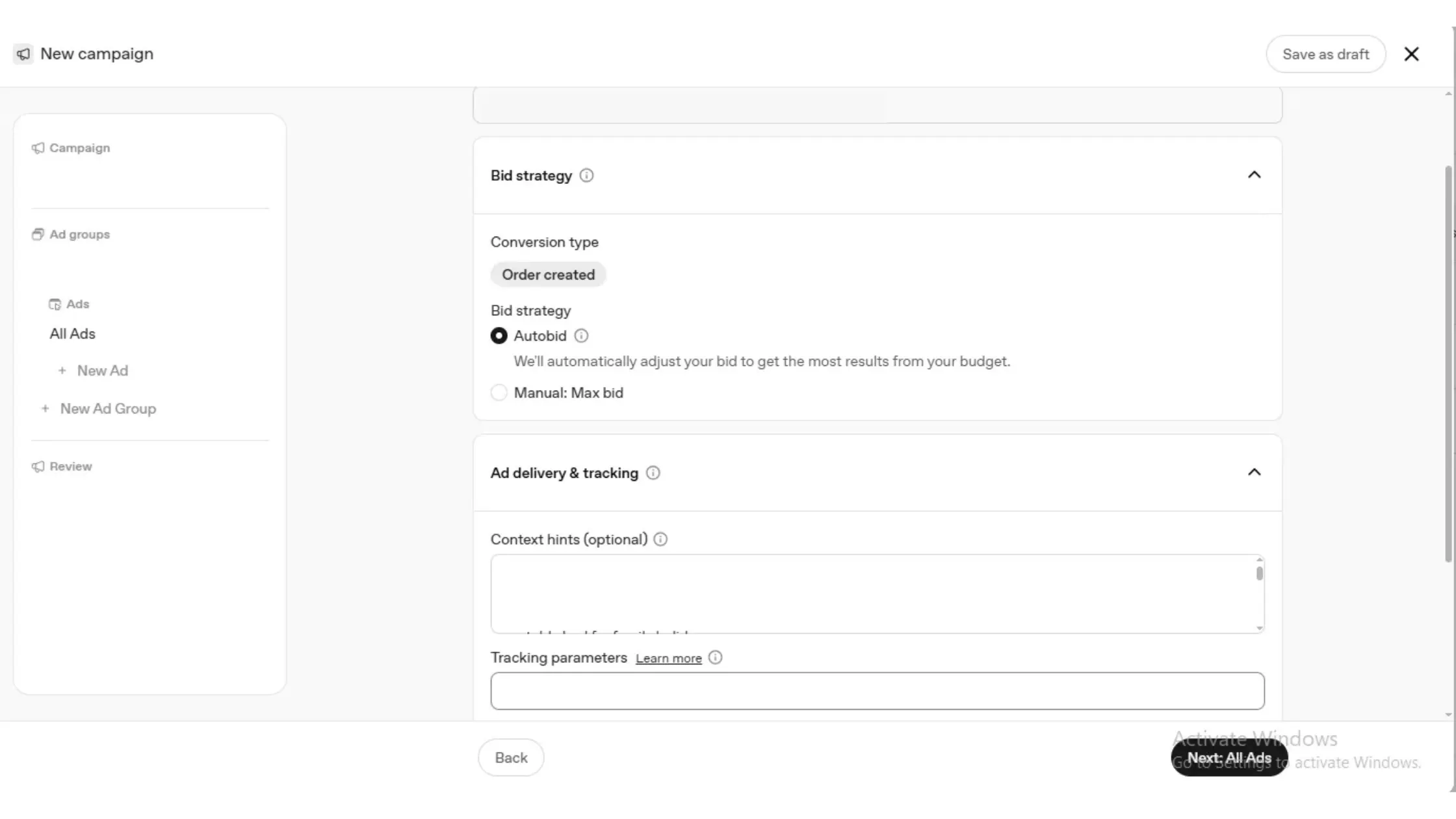
Ad group bid strategy, conversion type and context hints.

Choose a Bid Strategy

  • Autobid: OpenAI adjusts bids automatically to get the most results from your budget. Start here.
  • Manual: Max bid: You cap the bid yourself.

The conversion type shows the event you chose earlier, for example “Order created.”

Write Context Hints, Not Keywords

Context hints are short descriptions of the conversations where your ad belongs. They are not exact-match keywords and do not guarantee placement.

Weak hint: travel bed

Strong hint: portable inflatable bed for toddlers during family hotel stays

Write each hint as a real situation. Describe the product, who it helps and when it is useful. Mix product terms, use cases and buyer scenarios.

Set the Destination URL and Ad Group Tracking
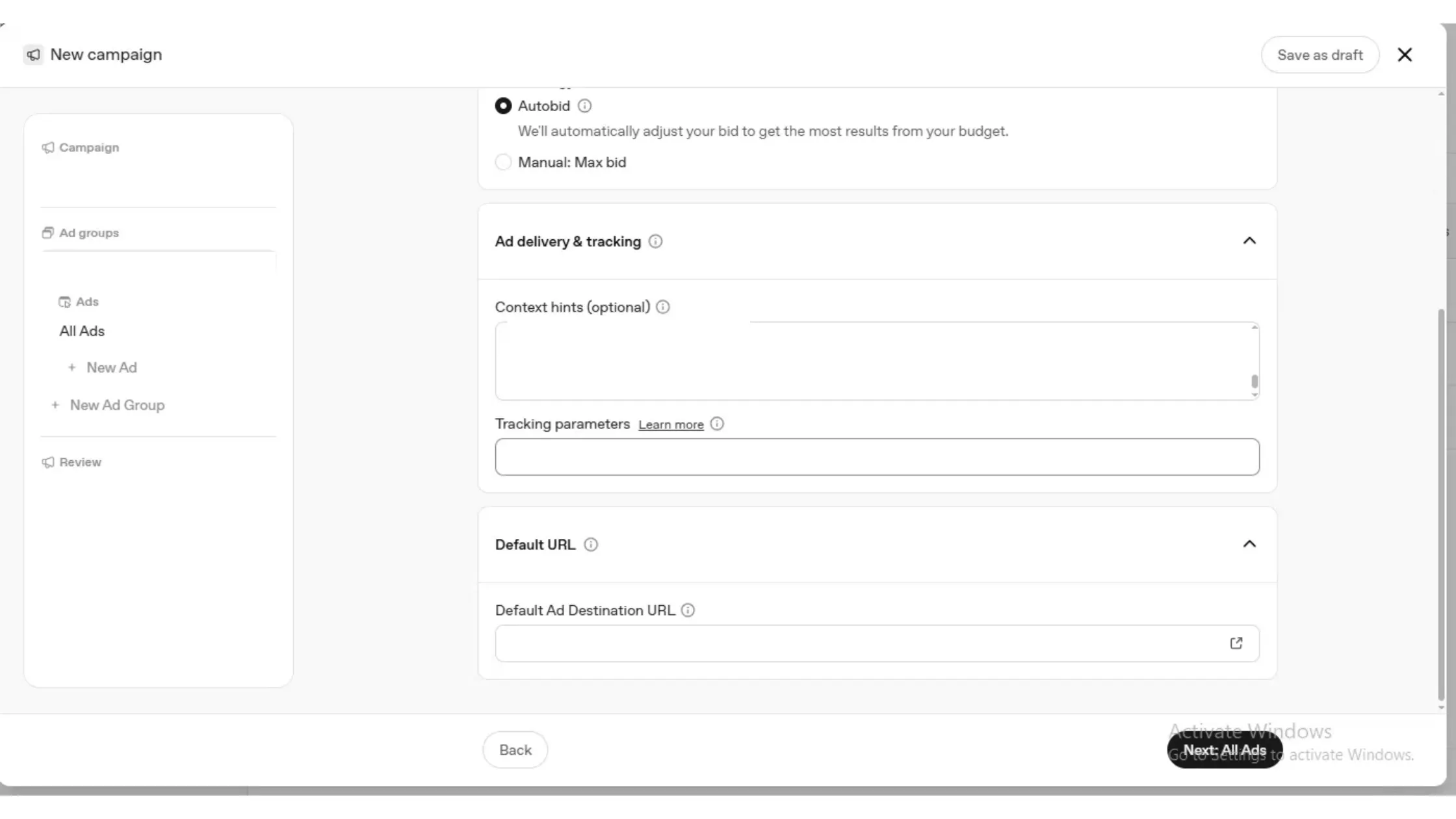
Ad group tracking parameters and Default Ad Destination URL

Add ad-group UTM tags so you can separate traffic in analytics:

utm_source=chatgpt&utm_medium=paid&utm_campaign=your_campaign&utm_content=your_ad_group

Then set the Default Ad Destination URL. Send people to the most relevant collection or product page, not your homepage.

Step 4: How to Write a ChatGPT Ad That Gets Approved

Open the ad group and click New Ad. A ChatGPT ad has four parts:

  • A title of up to 50 characters
  • A description of up to 100 characters
  • One square image (PNG or JPG, up to 1200 x 1200 pixels)
  • A landing page URL

Put your hook in the first 35 characters, because previews truncate the title. Write like a helpful recommendation, not a banner. Add three to five ad variations per ad group so you can compare results.

Step 5: How to Set Up ChatGPT Ads Conversion Tracking

Go to Tools > Conversions and create a data source. OpenAI gives you a Pixel ID and a script to place in your site’s head section. You can also send events through the Conversions API.

For ecommerce, track these standard events:

  • page_viewed
  • items_added
  • checkout_started
  • order_created

Without the pixel, a Conversions campaign has nothing to optimize toward. If you use both the pixel and the API, share an event ID so OpenAI counts each action once.

Also add these lines to your robots.txt so ad review can crawl your page:

User-agent: OAI-AdsBot

Allow: /


Step 6: How to Review and Launch Your ChatGPT Ad Campaign

The review step lists your campaign type, objective, billing method, locations, platforms, daily budget, tracking, ad group and ad. Check each line, then submit.

Set the campaign, ad group and ad to Active. Ads show “Serving” once review passes.

Why Is My ChatGPT Ad Not Serving? (Quick Fixes)

Hover over the status to see the reason.

Reason

Fix

Billing not set up

Add a billing profile and card

Verification incomplete

Finish verification, add name and logo

No active creatives

Add an ad and set every level to Active

Ad disapproved

Check the policy code and allow OAI-AdsBot

Budget below bid

Raise the budget or lower the bid


ChatGPT Ads Best Practices for Better Results

  • Give the campaign about 30 days before judging it.
  • Keep one theme per ad group so context hints stay tight.
  • Wait 24 to 48 hours for conversion data. Reporting lags delivery.
  • Compare ChatGPT traffic in analytics using your UTM tags.

Final Thoughts: Is Advertising on ChatGPT Worth It?

ChatGPT ads are worth a controlled test, especially in India, where the entry point is a ₹725 daily budget. The platform is still in beta. It has no video ads, no dayparting, no frequency caps, no keyword or demographic targeting and no prompt-level reporting, so you have less control than on Google or Meta.

The best way to start is simple. Pick one product, build one campaign with the Conversions objective, write specific context hints, install the pixel and run it for 30 days. Then compare cost per order against your other channels.

If you follow the six steps in this ChatGPT Ads Manager guide, you will launch with the right setup instead of debugging a “Not serving” campaign. Start small, track everything with UTM tags and scale only what converts.
 

Frequently asked questions

Sign up at ads.openai.com, complete verification and billing, then create a campaign, ad group and ad. Choose an objective, set a budget, write context hints and add the pixel before launching.

The minimum daily budget is ₹725. Conversions campaigns are billed per thousand impressions, while Clicks campaigns are billed per click.

Yes. Self-serve access opened to Indian businesses in September 2026, and ads show to adult users on the Free and Go plans.

No. You write context hints, which describe the conversations your ad fits. They are not exact-match controls.

The usual causes are missing billing, incomplete verification, no active ad, a disapproved ad or a budget below your bid. Hover over the status in Ads Manager to see which one applies.

Yes, but you must create the account yourself and invite the agency as an admin or member.

Small business outperforming big brands through smarter PPC strategy

There’s a major shift happening in digital advertising. Smarter PPC for Small Businesses is becoming a real advantage, allowing small brands to compete with and often outperform  big-budget giants. PPC is no longer a money game; it’s a strategy game, and small businesses are finally winning.

Yet, when it comes to PPC the quiet battlefield of clicks, intent, and data small businesses are pulling off something unexpected. They’re competing. And in many cases, they’re winning.

Running PPC campaigns used to feel like a money game. Whoever spent the most usually controlled the top spot. But things changed. Ad platforms evolved. Consumer behaviour shifted. Data became more powerful than budget alone. And that’s where the tables turned.

As someone who has worked with many businesses through Apex Web Zone (a digital team based in Ahmedabad serving clients worldwide), I’ve seen this story unfold repeatedly. A small brand with limited resources comes in, tired of losing to the Goliaths in their industry. They’re hungry to grow. They’re open to smarter strategies. And that’s enough to tilt the entire equation.

Let’s break down how small businesses are outsmarting big brands with smarter PPC and how you can join that winning side.

The New Reality: Agility Beats Deep Pockets

Big brands are famous for slow decisions. They have layers of approval, teams of strategists, long meetings, and fixed global processes. A simple change in ad copy can take days.

Small businesses move differently. They adjust daily. Sometimes hourly. They pivot fast because they have to survive. When trends shift, they react immediately. If something stops working, they change direction.

PPC rewards that kind of agility.

Platforms like Google Ads, Bing Ads, Amazon Ads, and Instagram thrive on fast learning loops. When a business tests often, data piles up faster. When decisions move quicker, results improve sooner. That’s why a small business with the right PPC Management Services partner can outperform brands ten times bigger.

Agility is a bigger asset than budget. And small businesses own it.

Use Case #1: Winning With Precision Targeting

A boutique skincare brand we worked with wanted to compete with huge global names. Their budget? Less than 6% of what big brands were spending each month.

Instead of spreading ads across vague audiences, we narrowed it down using intent-based segments. People searching for very specific needs. People looking for certain ingredients. People frustrated with expensive products that don’t work.

This hyper-focused targeting cut the competition and built relevance.

Big brands cast wide nets. Small brands shoot with accuracy.

That one change dropped their cost per click by 37% and increased conversions nearly fourfold. That’s the power of precision. And that’s the advantage a smaller, smarter team has.

Why Smarter PPC Wins Over Bigger PPC

To understand why small businesses are succeeding, just look at how platforms work today. They reward three things :

1. Relevance.

2. Speed Of Learning.

3. High-Quality User Signals.

And none of these require large budgets.

Let’s break them down.

  • Relevance Drives Everything

Google, Instagram, and Amazon don’t care about your ad budget. They want users to see helpful, high-quality ads. When your campaign is relevant, platforms give you better placement and lower CPC.

Small businesses are better at relevance because they know their customers personally. They understand pain points, behaviour, and emotions deeply.

  • Speed Of Learning

Small brands experiment fast. Test quickly. Adapt daily. Every small shift a headline tweak, a new keyword, a fresh visual helps the algorithm learn.

Big brands wait for approval, meetings, and layers of bureaucracy.

  • User Signals Beat Money

A relevant ad clicked by the right user will always outperform an expensive ad shown to the wrong person.

This is why smarter beats bigger.

How Different PPC Channels Help Small Businesses Win

Big brands go heavy on Google. Small businesses spread budgets across channels where competition is lower and intent is higher. This is exactly where services like Amazon Ads Management, Instagram Advertising Services, and Bing Ads Specialist expertise shine.

Here’s a quick comparison of how platforms support small brands :

PlatformWhy Small Businesses Gain AdvantageIdeal For
Google AdsIntent-driven, fast testing, low waste with proper setup.Global reach, service businesses
Instagram AdsVisual storytelling, niche communities, strong engagementLifestyle, fashion, wellness, consumer brands
Bing AdsLower competition, cheaper CPC, higher-quality usersB2B, tech, local service providers
Amazon AdsBuyers with high purchase intent, product-focused visibilityeCommerce, DTC brands
Amazon Paid AdvertisingOutranks bigger sellers if optimized wellNiche product categories

When you combine multiple platforms with the right strategy, you create a PPC engine that big brands struggle to match.

Use Case #2: Beating Big Brands On Amazon Ads

One of our clients sold handmade kitchen products. They were competing against massive sellers on Amazon.

But bigger sellers weren’t running precise long-tail ads. They weren’t analyzing shopper search terms daily. They weren’t adjusting bids at the micro level.

We used Amazon Paid Advertising strategies with smart refinements :

  • Specific product-use keywords.
  • Negative keyword pruning.
  • Time-of-day bid control.
  • Review-based ad segmentation.

Sales jumped 212% in eight weeks.

Small sellers beating multi-million-dollar brands all with smarter ads.

Use Case #3: Bing The Underrated Goldmine

Small businesses love platforms big brands ignore. Bing Ads is a perfect example. As a Bing Ads Specialist, we’ve seen CPCs nearly 40–60% lower than Google in many regions.

Why? Simple. Big brands don’t pay attention to Bing.

But Bing users are high-quality. Many work on office computers where Bing is the default search engine. And they buy more often.

One of our clients in the home improvement niche saw better ROI on Bing than Google for one-third the cost.

This is where small businesses thrive. While big brands compete in crowded spaces, smaller brands quietly dominate the overlooked platforms.

Smarter PPC Means Smarter Systems, Not Bigger Budgets

The secret isn’t spending more. It’s spending better.

Smarter PPC is built on simple pillars :

  • Understand what your customer wants.
  • Show the right message at the right moment.
  • Avoid wasting money on broad keywords.
  • Keep refining instead of letting campaigns run blindly.
  • Use data like a compass, not a report card.

When you follow this approach, your budget stretches. Your relevance improves. Your campaigns get stronger every week.

And yes you can absolutely beat big brands with this mindset.

How Apex Web Zone Helps Small Businesses Win

At Apex Web Zone, we’ve worked with brands in India and across the world. Many were small. Many had limited budgets. Most were frustrated because bigger competitors were dominating search results and social feeds.

But once we set up smarter systems using :

  • Strategic PPC Management Services.
  • Platform-specific funnels.
  • Intent-based keyword clusters.
  • Daily micro-optimizations.
  • Amazon Ads Management focus.
  • Instagram Advertising Services for storytelling.
  • Bing Ads specialist campaigns for cheaper conversions.

…everything changed.

Small budgets started producing big results. Conversions increased. Wasted spend dropped. Revenue accelerated.

Because the truth is simple : PPC Success Isn’t About Size. It’s About Strategy.

What Small Businesses Can Do Today To Compete Better

Here are three simple actions you can take immediately :

1. Stop Targeting Broad Keywords.

Big brands love them. Let them waste their money. You go niche.

2. Focus On Buyer Intent, Not Vanity Metrics.

Clicks don’t build companies. Customers do.

3. Use At Least Two PPC Platforms.

  • Google + Instagram.
  • Bing + Amazon.
  • Meta + Google.

Choose combinations that fit your audience.

When you do this consistently, your PPC campaigns become sharper, more efficient, and more profitable.

Final Thoughts: This Is The Small Business Era

In the past, big brands dominated because of budget alone. But PPC leveled the field. Today, data is the great equalizer. Agility is the multiplier. Creativity is the weapon.

Small businesses who understand this are rewriting the rules of online advertising. And with the right strategy, tools, and management it’s not only possible to compete with big brands…

It’s absolutely possible to beat them.

If you ever need help building smarter campaigns, the team at Apex Web Zone is always here, guiding small businesses across the globe from our base in Ahmedabad.

Because in this new world of smarter PPC, size doesn’t matter.

Strategy does.

FAQ's

Q1. How are small businesses beating big brands in PPC?

They move faster. While big brands drown in meetings, small businesses tweak ads daily, test aggressively, and sharpen targeting giving them better relevance and lower costs.

Q2. Does a small business need a huge budget to run successful PPC?

Not at all. Modern PPC rewards smart targeting and data-driven decisions, not big wallets. A tight strategy can outperform a bloated budget any day.

Q3. Which PPC platforms work best for small businesses?

Google, Instagram, Bing, and Amazon all work well depending on the audience. Many small brands win big by combining two platforms instead of relying on just one.

Q4. Why is precision targeting so important in PPC?

Because broad targeting burns money. Precision targeting reaches people with clear intent, reduces CPC, improves relevance, and boosts conversions.

Q5. How can Apex Web Zone help small businesses grow with PPC?

By building smarter, leaner PPC systems intent-based keywords, daily optimization, platform-specific funnels, and multi-channel strategies that stretch every rupee like magic.

A marketing professional analyzing PPC performance graphs to improve ad conversions.

Imagine your website as a quiet shop on a busy street. People pass by, glance at the sign, maybe stop for a moment but only a few walk in. Now picture a bright, well-placed sign that appears right in front of people already looking for exactly what you offer. They don’t just stop; they step inside, ready to talk.

That’s what a well-planned PPC strategy does. It turns casual interest into intent-driven conversions and when done right, it can triple your monthly inquiries without inflating your ad spend.

Clicks Don’t Build Businesses Conversions Do

Many businesses fall into the trap of chasing clicks instead of conversions. High traffic looks good on paper, but if the right audience isn’t engaging, it’s wasted effort. At Apex Web Zone, we’ve built campaigns where fewer clicks brought in more qualified inquiries, simply because each ad was designed with precision. A good PPC strategy doesn’t ask, “How many people can I reach?” It asks, “Who’s ready to take action right now?”

The Strategy Behind The Surge

There’s no secret formula for tripling inquiries. The results come from structure, creativity, and consistency. Here’s how a well-executed PPC strategy achieves meaningful growth.

Targeting By Intent, Not Just Keywords

Every search tells a story. Someone typing “hire a website development company” is far more valuable than someone searching “what is website development.” We focus on intent-based targeting identifying users who are ready to engage. Instead of broad terms, we target long-tail phrases, location-specific intent, and behavioral data to connect your ads with users already in decision mode.

This targeting precision ensures your budget goes toward people who are far more likely to inquire, not just browse.

Ad Psychology: Writing For Humans, Not Algorithms

An ad’s success isn’t just in where it appears but in how it speaks. Good PPC copy bridges logic and emotion it’s concise, clear, and honest. Compare these two examples :

  • “Affordable web design agency for small businesses.”
  • “Get a website that brings real clients, not just clicks.”

The second line doesn’t sell features; it sells outcomes. It talks like a person, not a campaign. At Apex Web Zone, we focus on this kind of clarity-driven storytelling, which creates connection and urgency without overpromising.

Design That Converts, Not Just Attracts

A click only matters if it leads to action. That’s why your landing page matters as much as your ad. A strong PPC strategy doesn’t end when the user clicks it starts there. We build conversion-oriented landing pages that are :

  • Fast-loading and mobile-responsive.
  • Focused on a single call-to-action.
  • Consistent with the ad message.
  • Designed with trust elements such as testimonials, visuals, and clear next steps.

As a Branding and Design Agency, we believe that the page’s experience should mirror the promise in the ad. That seamless continuity is what convinces people to fill out that form or make that call.

Continuous Optimization For Continuous Results

A static campaign is a dying campaign. Search trends shift, user behavior evolves, and competitors adjust their bids daily. That’s why every campaign we manage is dynamic. We monitor and adjust in real time :

  • Updating ad copy and visuals based on performance data.
  • Refining audience segments to improve cost-per-click.
  • Testing different landing page layouts for higher conversion rates.
  • Reallocating budget toward high-performing campaigns.

This ongoing optimization is how businesses sustain consistent inquiry growth instead of short-term spikes.

Expanding Across The Right Platforms

Great PPC strategies don’t rely on one platform. Each audience behaves differently depending on where they are online. Our team at Apex Web Zone integrates campaigns across :

  • Google Ads for core search visibility.
  • Instagram Advertising Services for discovery and engagement.
  • Amazon Ads Management for direct eCommerce conversion.
  • Bing Ads Specialists for overlooked but high-value traffic sources.

This multi-channel approach ensures that your message finds people at every stage of their journey from curiosity to inquiry.

From Data To Decisions

Data without interpretation is noise. We translate performance metrics into clear, actionable insights so you always know how your campaigns perform. Our reporting focuses on :

  • Cost per inquiry (CPI).
  • Conversion rate (CVR).
  • Return on ad spend (ROAS).
  • Inquiry source attribution.

Transparency drives smarter decisions. You’ll always see where your investment goes and what it returns.

Why Apex Web Zone

With more than eight years of experience, Apex Web Zone isn’t just another Digital Marketing Agency we’re a team that bridges creativity and analytics. As a full-service partner, we integrate PPC Management Services, Custom Web Development, and E–commerce SEO Solutions to create unified growth systems, not isolated campaigns. Our campaigns are built to scale, designed to convert, and crafted with one principle: your success should compound, not fluctuate.

The Compound Effect Of Smart PPC

When every element of your campaign targeting, messaging, design, optimization works in harmony, your inquiry numbers don’t just rise, they multiply.

  • It’s not about spending more.
  • It’s about spending with precision.

That’s the power of a good PPC strategy: it doesn’t chase clicks; it creates conversions. It turns interest into opportunity, and browsers into buyers.

Start The Conversion

If you’re ready to move from sporadic leads to predictable inquiries, it’s time to refine your PPC approach.At Apex Web Zone, we combine data intelligence, creative precision, and real-time adaptability to help your campaigns do more than perform they deliver.

Your Audience Is Already Searching. Let’s Make Sure They Find You First.

FAQ’s

1. What is PPC and how does it help increase business inquiries?

PPC (Pay-Per-Click) advertising places your brand in front of people actively searching for your services, generating targeted inquiries instead of random visits.

2. How quickly can I see results from a PPC campaign?

Initial results often appear within days, but consistent optimization over a few weeks brings the most sustainable growth in inquiries and conversions.

3. Why should I choose Apex Web Zone for PPC management?

Apex Web Zone combines strategy, design, and analytics to create campaigns that not only attract clicks but convert them into genuine leads and clients.

4. What platforms deliver the best PPC results?

Google Ads usually leads, but integrating Bing, Amazon, and Instagram ads can diversify reach and improve overall ROI.

5. How do you measure PPC success?

We track key metrics such as cost per inquiry (CPI), conversion rate, and return on ad spend (ROAS) to ensure your investment delivers measurable results.
