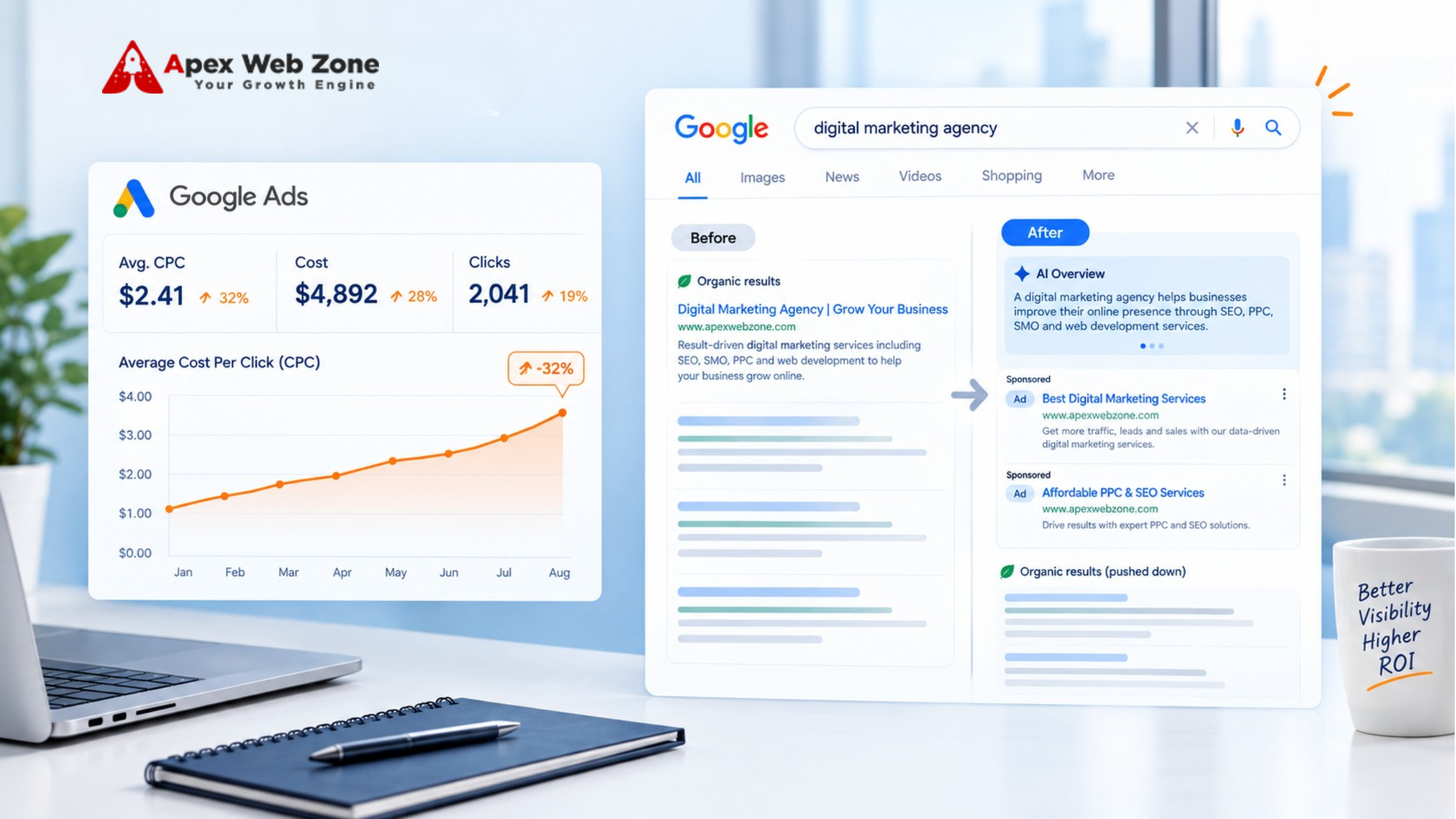
The average cost per click on Google Ads hit $5.42 in 2026 — more than double the $2.32 advertisers paid a decade ago. If your account feels more expensive to run than it did even two years ago, you’re not imagining it, and you’re not doing anything wrong.
Rising Google Ads costs have become the defining pain point for small and mid-sized advertisers this year. Budgets that used to stretch across a full quarter now run dry in weeks, and the usual fixes — tightening keywords, trimming dayparting — aren’t moving the needle the way they used to. That’s because the pressure isn’t coming from your account settings. It’s structural.
This article breaks down the three forces actually driving rising Google Ads costs in 2026, what they mean for your Google Ads ROI, and the audit framework that separates advertisers who are bleeding margin from those who are protecting it.
The Real Driver Behind Rising Google Ads Costs
Rising Google Ads costs aren’t primarily a story about Google raising prices. They’re a story about a shrinking supply of clickable search real estate meeting a growing number of advertisers who need it. According to LocaliQ’s 2026 benchmark report, cost-per-click rose across the majority of industries tracked this year, continuing a trend that has held since the platform’s benchmarking began in 2016.
More businesses are running paid search than ever, and automated bidding systems now compete against each other in real time, each trying to win the same limited inventory of first-page positions. When ten advertisers are bidding for eight visible slots instead of twelve, the auction clears higher — every time, regardless of your account quality.
For marketing leaders, the takeaway isn’t to panic about cost-per-click increases. It’s to stop benchmarking this year’s CPC against last year’s and start benchmarking cost per acquisition instead. This sets up the next problem: a major structural shift in where those clicks are even happening.
AI Overviews Are Quietly Driving Cost-Per-Click Increases
Search results pages look nothing like they did three years ago. AI-generated summaries now sit above the organic listings on a large share of commercial queries, and they’re changing where users click — or whether they click at all.
According to Pew Research Center (2025), Google users click a traditional search result only 8% of the time when an AI-generated summary appears, compared to 15% when it doesn’t — a decline of nearly half. That lost organic traffic doesn’t disappear. It gets displaced into the paid auction, where businesses that once relied on ranking well organically now have to bid for visibility they used to get for free.
This is one of the least-discussed drivers of rising Google Ads costs: it’s not just more advertisers competing for clicks, it’s fewer free clicks available in the first place. Every business pushed out of an organic listing by an AI summary is a business now bidding on paid ads to recover that same visibility — which tightens the auction further and raises your paid media budget requirements just to hold flat traffic.
Automation Is Adding Pressure to Your Paid Media Budget
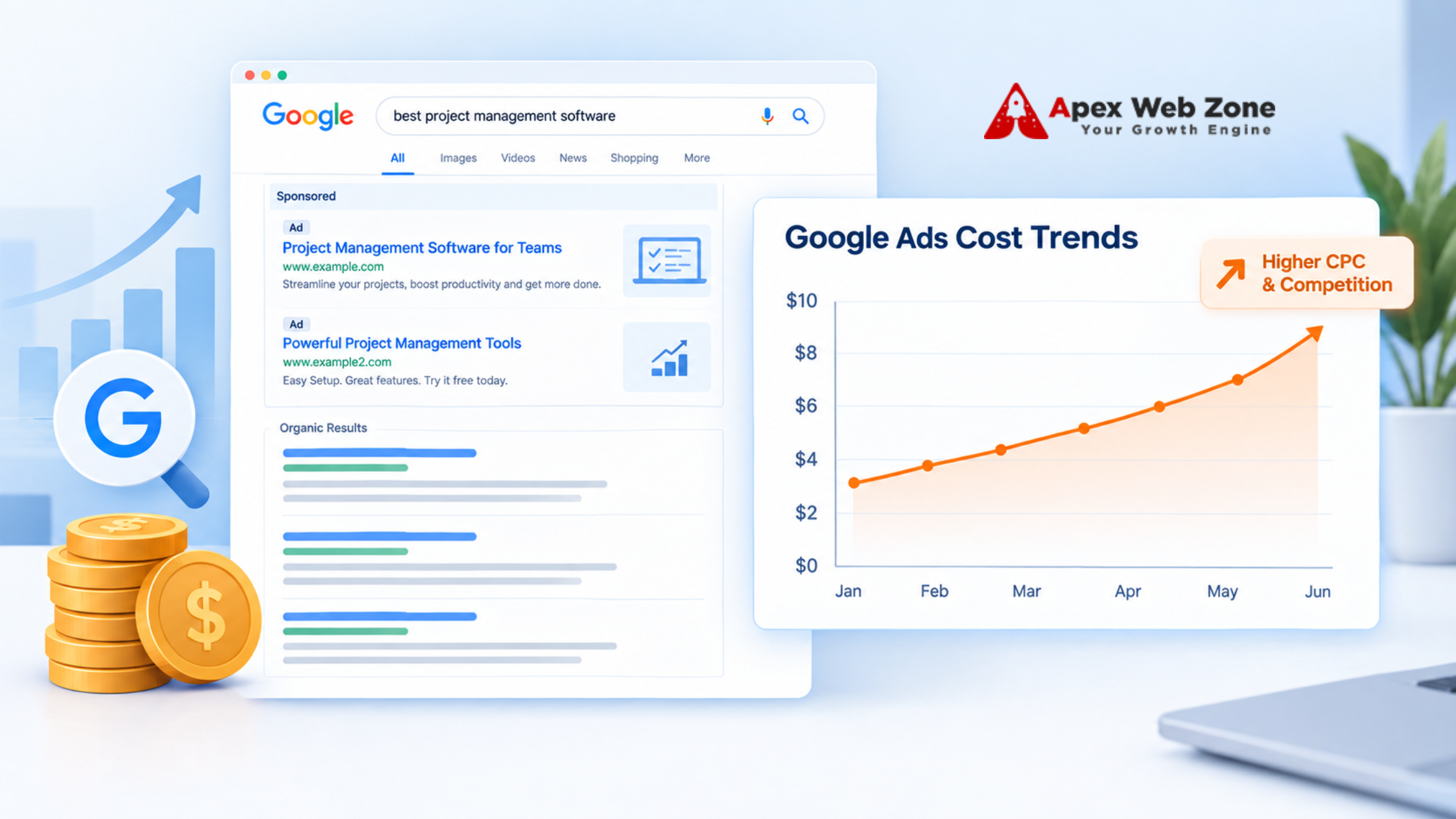
Google’s Performance Max and automated bidding strategies are now the default for most accounts, and they’ve genuinely improved conversion quality for many advertisers. But automation runs on volume and speed, and both push spend upward. Automated bidding systems adjust in real time to what competitors are doing, which means costs can climb even when your own account hasn’t changed a single setting.
WordStream by LocaliQ’s 2026 industry benchmarks found conversion rates improved across the majority of industries even as CPCs rose — evidence that automation is often raising costs and results together, not costs alone. The practical implication for your paid media budget: a rising CPC is not automatically a losing signal. What matters is whether cost per lead is moving in the same direction.
That distinction matters because it changes what you should actually be auditing — and that’s where Quality Score comes back into the picture.
The Quality Score Optimization Most Small Businesses Skip
Quality Score is the one lever inside your control that directly discounts your cost relative to competitors bidding on the same terms. It’s calculated from expected click-through rate, ad relevance, and landing page experience — and most small business accounts have never had a real landing page audit run against it.
Quality Score optimization is unglamorous work: matching ad copy tightly to landing page content, cutting page load time, removing generic homepage redirects in favor of pages that answer the exact search query. But it’s the difference between two businesses bidding the same amount and getting very different costs per click. A page built specifically around the searcher’s intent consistently outperforms a repurposed homepage on both Quality Score and conversion rate.
Skipping this step means absorbing the full weight of rising Google Ads costs with no offset. Fixing it doesn’t eliminate the trend — but it determines how exposed your account is to it.
What Rising CPCs Actually Cost Your Google Ads ROI
Here’s the number that matters more than CPC on its own: well-optimized paid search campaigns are still producing $2 to $8 in return for every $1 spent in 2026, even with higher clicks costs. Google Ads ROI hasn’t collapsed — it’s become more dependent on execution quality than it was when clicks were cheap and forgiving.
The businesses struggling aren’t necessarily the ones paying the highest CPCs. They’re the ones still measuring success by cost per click instead of cost per qualified lead. A $6 click that converts at 8% is cheaper, in real terms, than a $3 click converting at 2%. Rising Google Ads costs punish accounts that haven’t tightened conversion tracking, because without clean data, automated bidding optimizes toward the wrong outcome entirely.
Protecting margin now means treating every dollar of ad spend as a pipeline input to be measured, not a line item to be trimmed reflexively.
A Practical PPC Audit Framework to Protect Your Margins
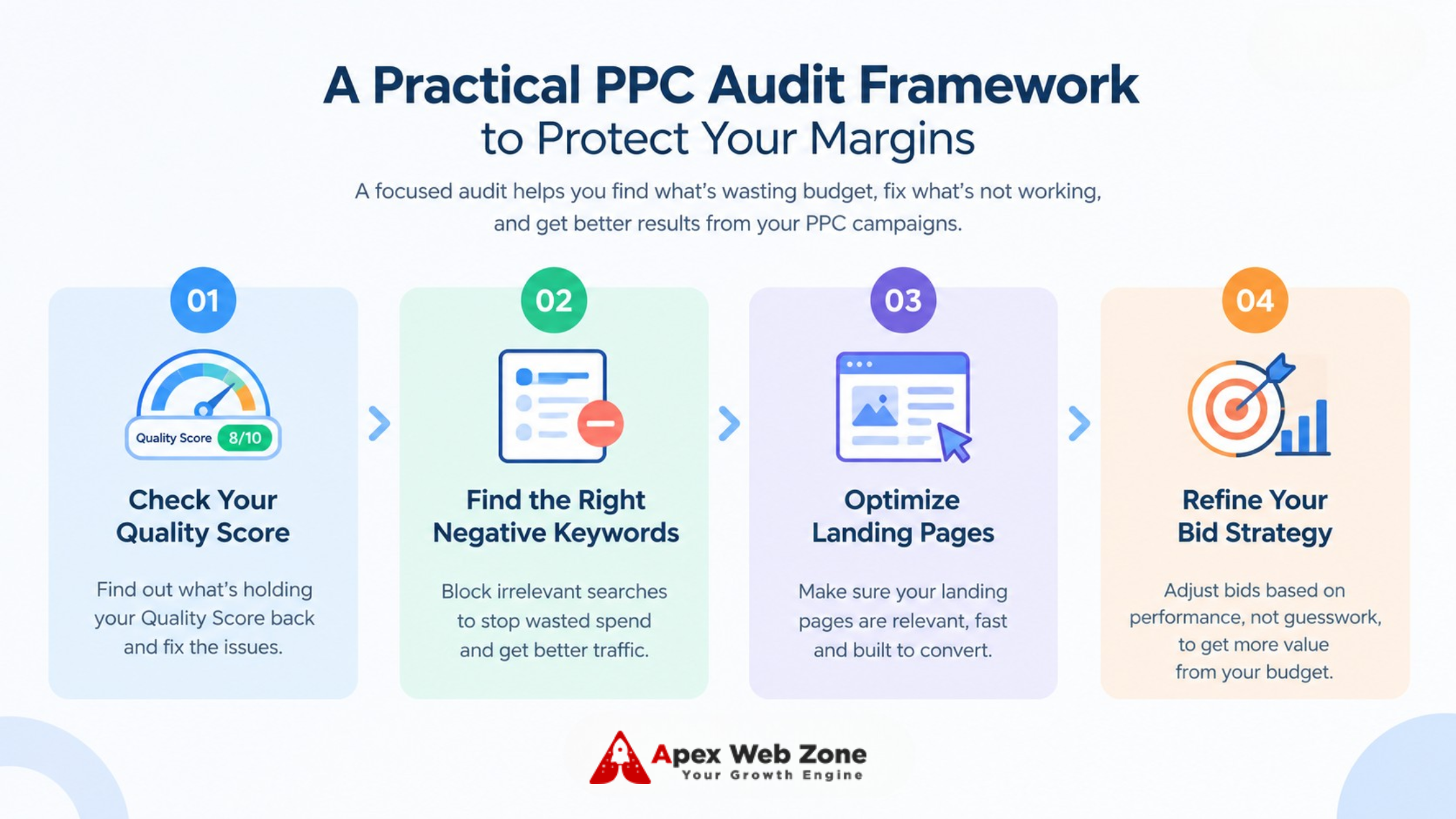
A PPC audit doesn’t need to be a quarterly overhaul. The highest-leverage version is a short, repeatable checklist run monthly:
- Negative keyword review — cut spend leaking to irrelevant queries before touching bids
- Quality Score check — flag any ad group scoring below 5 and rework ad-to-landing-page relevance
- Conversion tracking audit — confirm every form, call, and chat conversion is firing correctly before trusting automated bidding decisions
- Brand vs. non-brand separation — isolate branded search into its own campaign so cheap, high-intent clicks don’t get buried in blended reporting
- Impression share tracking — rising CPC alongside falling impression share signals competitors are outbidding you, not just market-wide inflation
Run the quick wins first — the negative keyword pass and Quality Score flags typically surface within a week. The structural work, like landing page rebuilds, takes longer but compounds.
This is where most in-house teams run out of bandwidth — not because the framework is complex, but because it needs consistent attention every month, not a one-time fix.
Frequently Asked Questions
Why are Google Ads costs rising so fast in 2026?
Rising Google Ads costs are driven by three overlapping forces: more advertisers competing for a limited pool of first-page auction slots, AI-generated search summaries displacing organic clicks into the paid market, and automated bidding systems reacting to competitor behavior in real time. No single fix reverses the trend, but Quality Score work and tighter conversion tracking reduce how exposed your account is to it. Most businesses see the clearest impact within one to two billing cycles of a focused audit.
Should I pause my campaigns until costs come back down?
Pausing rarely helps, because rising Google Ads costs reflect a structural shift in the auction, not a temporary spike likely to reverse. Stepping away also resets Quality Score history and the learning phase for automated bidding, which often makes relaunching more expensive than staying the course. A better move is auditing conversion tracking and Quality Score before deciding whether to reduce, hold, or reallocate budget.
Does a higher cost per click always mean worse ROI?
No. Google Ads ROI depends on cost per qualified lead, not cost per click in isolation. A higher-cost click that converts at a strong rate can produce better returns than a cheaper click with a weak conversion rate. This is why cost-per-acquisition, not CPC, should be the primary metric tracked month over month.
How often should I run a PPC audit given rising costs?
A lightweight PPC audit — negative keywords, Quality Score flags, and conversion tracking — is worth running monthly rather than quarterly in the current environment. Deeper structural work, like landing page rebuilds or full account restructures, can follow a longer cycle, but the monthly pass catches waste before it compounds across a full quarter of spend.
Stop Absorbing the Increase. Start Auditing Your Account.
Rising Google Ads costs aren’t a phase that resolves itself — they reflect a paid search market that has matured, with AI-driven search behavior and automated bidding both adding permanent pressure to the auction. The advertisers protecting margin in 2026 aren’t the ones paying the lowest CPC. They’re the ones who’ve stopped measuring success by click cost alone and started running consistent Quality Score and conversion-tracking audits against their paid media budget.
If your account hasn’t had a real audit run against it this quarter, that’s the highest-leverage place to start before adjusting a single bid.
