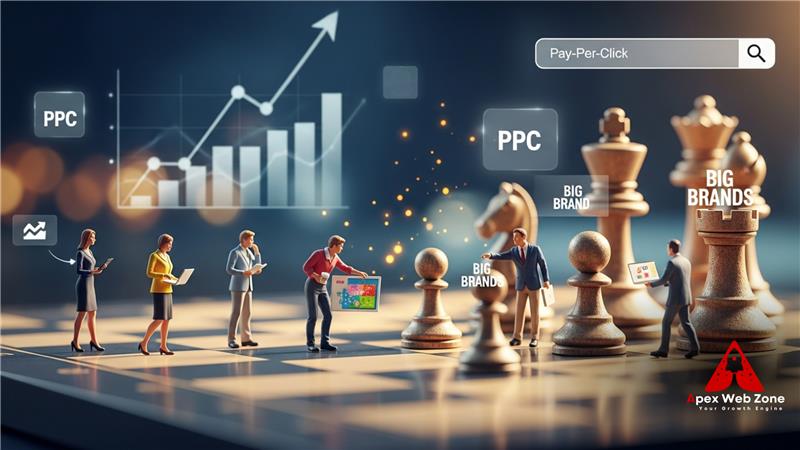
There’s a major shift happening in digital advertising. Smarter PPC for Small Businesses is becoming a real advantage, allowing small brands to compete with and often outperform big-budget giants. PPC is no longer a money game; it’s a strategy game, and small businesses are finally winning.
Yet, when it comes to PPC the quiet battlefield of clicks, intent, and data small businesses are pulling off something unexpected. They’re competing. And in many cases, they’re winning.
Running PPC campaigns used to feel like a money game. Whoever spent the most usually controlled the top spot. But things changed. Ad platforms evolved. Consumer behaviour shifted. Data became more powerful than budget alone. And that’s where the tables turned.
As someone who has worked with many businesses through Apex Web Zone (a digital team based in Ahmedabad serving clients worldwide), I’ve seen this story unfold repeatedly. A small brand with limited resources comes in, tired of losing to the Goliaths in their industry. They’re hungry to grow. They’re open to smarter strategies. And that’s enough to tilt the entire equation.
Let’s break down how small businesses are outsmarting big brands with smarter PPC and how you can join that winning side.
The New Reality: Agility Beats Deep Pockets
Big brands are famous for slow decisions. They have layers of approval, teams of strategists, long meetings, and fixed global processes. A simple change in ad copy can take days.
Small businesses move differently. They adjust daily. Sometimes hourly. They pivot fast because they have to survive. When trends shift, they react immediately. If something stops working, they change direction.
PPC rewards that kind of agility.
Platforms like Google Ads, Bing Ads, Amazon Ads, and Instagram thrive on fast learning loops. When a business tests often, data piles up faster. When decisions move quicker, results improve sooner. That’s why a small business with the right PPC Management Services partner can outperform brands ten times bigger.
Agility is a bigger asset than budget. And small businesses own it.
Use Case #1: Winning With Precision Targeting
A boutique skincare brand we worked with wanted to compete with huge global names. Their budget? Less than 6% of what big brands were spending each month.
Instead of spreading ads across vague audiences, we narrowed it down using intent-based segments. People searching for very specific needs. People looking for certain ingredients. People frustrated with expensive products that don’t work.
This hyper-focused targeting cut the competition and built relevance.
Big brands cast wide nets. Small brands shoot with accuracy.
That one change dropped their cost per click by 37% and increased conversions nearly fourfold. That’s the power of precision. And that’s the advantage a smaller, smarter team has.
Why Smarter PPC Wins Over Bigger PPC
To understand why small businesses are succeeding, just look at how platforms work today. They reward three things :
1. Relevance.
2. Speed Of Learning.
3. High-Quality User Signals.
And none of these require large budgets.
Let’s break them down.
- Relevance Drives Everything
Google, Instagram, and Amazon don’t care about your ad budget. They want users to see helpful, high-quality ads. When your campaign is relevant, platforms give you better placement and lower CPC.
Small businesses are better at relevance because they know their customers personally. They understand pain points, behaviour, and emotions deeply.
- Speed Of Learning
Small brands experiment fast. Test quickly. Adapt daily. Every small shift a headline tweak, a new keyword, a fresh visual helps the algorithm learn.
Big brands wait for approval, meetings, and layers of bureaucracy.
- User Signals Beat Money
A relevant ad clicked by the right user will always outperform an expensive ad shown to the wrong person.
This is why smarter beats bigger.
How Different PPC Channels Help Small Businesses Win
Big brands go heavy on Google. Small businesses spread budgets across channels where competition is lower and intent is higher. This is exactly where services like Amazon Ads Management, Instagram Advertising Services, and Bing Ads Specialist expertise shine.
Here’s a quick comparison of how platforms support small brands :
| Platform | Why Small Businesses Gain Advantage | Ideal For |
| Google Ads | Intent-driven, fast testing, low waste with proper setup. | Global reach, service businesses |
| Instagram Ads | Visual storytelling, niche communities, strong engagement | Lifestyle, fashion, wellness, consumer brands |
| Bing Ads | Lower competition, cheaper CPC, higher-quality users | B2B, tech, local service providers |
| Amazon Ads | Buyers with high purchase intent, product-focused visibility | eCommerce, DTC brands |
| Amazon Paid Advertising | Outranks bigger sellers if optimized well | Niche product categories |
When you combine multiple platforms with the right strategy, you create a PPC engine that big brands struggle to match.
Use Case #2: Beating Big Brands On Amazon Ads
One of our clients sold handmade kitchen products. They were competing against massive sellers on Amazon.
But bigger sellers weren’t running precise long-tail ads. They weren’t analyzing shopper search terms daily. They weren’t adjusting bids at the micro level.
We used Amazon Paid Advertising strategies with smart refinements :
- Specific product-use keywords.
- Negative keyword pruning.
- Time-of-day bid control.
- Review-based ad segmentation.
Sales jumped 212% in eight weeks.
Small sellers beating multi-million-dollar brands all with smarter ads.
Use Case #3: Bing The Underrated Goldmine
Small businesses love platforms big brands ignore. Bing Ads is a perfect example. As a Bing Ads Specialist, we’ve seen CPCs nearly 40–60% lower than Google in many regions.
Why? Simple. Big brands don’t pay attention to Bing.
But Bing users are high-quality. Many work on office computers where Bing is the default search engine. And they buy more often.
One of our clients in the home improvement niche saw better ROI on Bing than Google for one-third the cost.
This is where small businesses thrive. While big brands compete in crowded spaces, smaller brands quietly dominate the overlooked platforms.
Smarter PPC Means Smarter Systems, Not Bigger Budgets
The secret isn’t spending more. It’s spending better.
Smarter PPC is built on simple pillars :
- Understand what your customer wants.
- Show the right message at the right moment.
- Avoid wasting money on broad keywords.
- Keep refining instead of letting campaigns run blindly.
- Use data like a compass, not a report card.
When you follow this approach, your budget stretches. Your relevance improves. Your campaigns get stronger every week.
And yes you can absolutely beat big brands with this mindset.
How Apex Web Zone Helps Small Businesses Win
At Apex Web Zone, we’ve worked with brands in India and across the world. Many were small. Many had limited budgets. Most were frustrated because bigger competitors were dominating search results and social feeds.
But once we set up smarter systems using :
- Strategic PPC Management Services.
- Platform-specific funnels.
- Intent-based keyword clusters.
- Daily micro-optimizations.
- Amazon Ads Management focus.
- Instagram Advertising Services for storytelling.
- Bing Ads specialist campaigns for cheaper conversions.
…everything changed.
Small budgets started producing big results. Conversions increased. Wasted spend dropped. Revenue accelerated.
Because the truth is simple : PPC Success Isn’t About Size. It’s About Strategy.
What Small Businesses Can Do Today To Compete Better
Here are three simple actions you can take immediately :
1. Stop Targeting Broad Keywords.
Big brands love them. Let them waste their money. You go niche.
2. Focus On Buyer Intent, Not Vanity Metrics.
Clicks don’t build companies. Customers do.
3. Use At Least Two PPC Platforms.
- Google + Instagram.
- Bing + Amazon.
- Meta + Google.
Choose combinations that fit your audience.
When you do this consistently, your PPC campaigns become sharper, more efficient, and more profitable.
Final Thoughts: This Is The Small Business Era
In the past, big brands dominated because of budget alone. But PPC leveled the field. Today, data is the great equalizer. Agility is the multiplier. Creativity is the weapon.
Small businesses who understand this are rewriting the rules of online advertising. And with the right strategy, tools, and management it’s not only possible to compete with big brands…
It’s absolutely possible to beat them.
If you ever need help building smarter campaigns, the team at Apex Web Zone is always here, guiding small businesses across the globe from our base in Ahmedabad.
Because in this new world of smarter PPC, size doesn’t matter.
Strategy does.
FAQ's
They move faster. While big brands drown in meetings, small businesses tweak ads daily, test aggressively, and sharpen targeting giving them better relevance and lower costs.
Not at all. Modern PPC rewards smart targeting and data-driven decisions, not big wallets. A tight strategy can outperform a bloated budget any day.
Google, Instagram, Bing, and Amazon all work well depending on the audience. Many small brands win big by combining two platforms instead of relying on just one.
Because broad targeting burns money. Precision targeting reaches people with clear intent, reduces CPC, improves relevance, and boosts conversions.
By building smarter, leaner PPC systems intent-based keywords, daily optimization, platform-specific funnels, and multi-channel strategies that stretch every rupee like magic.
